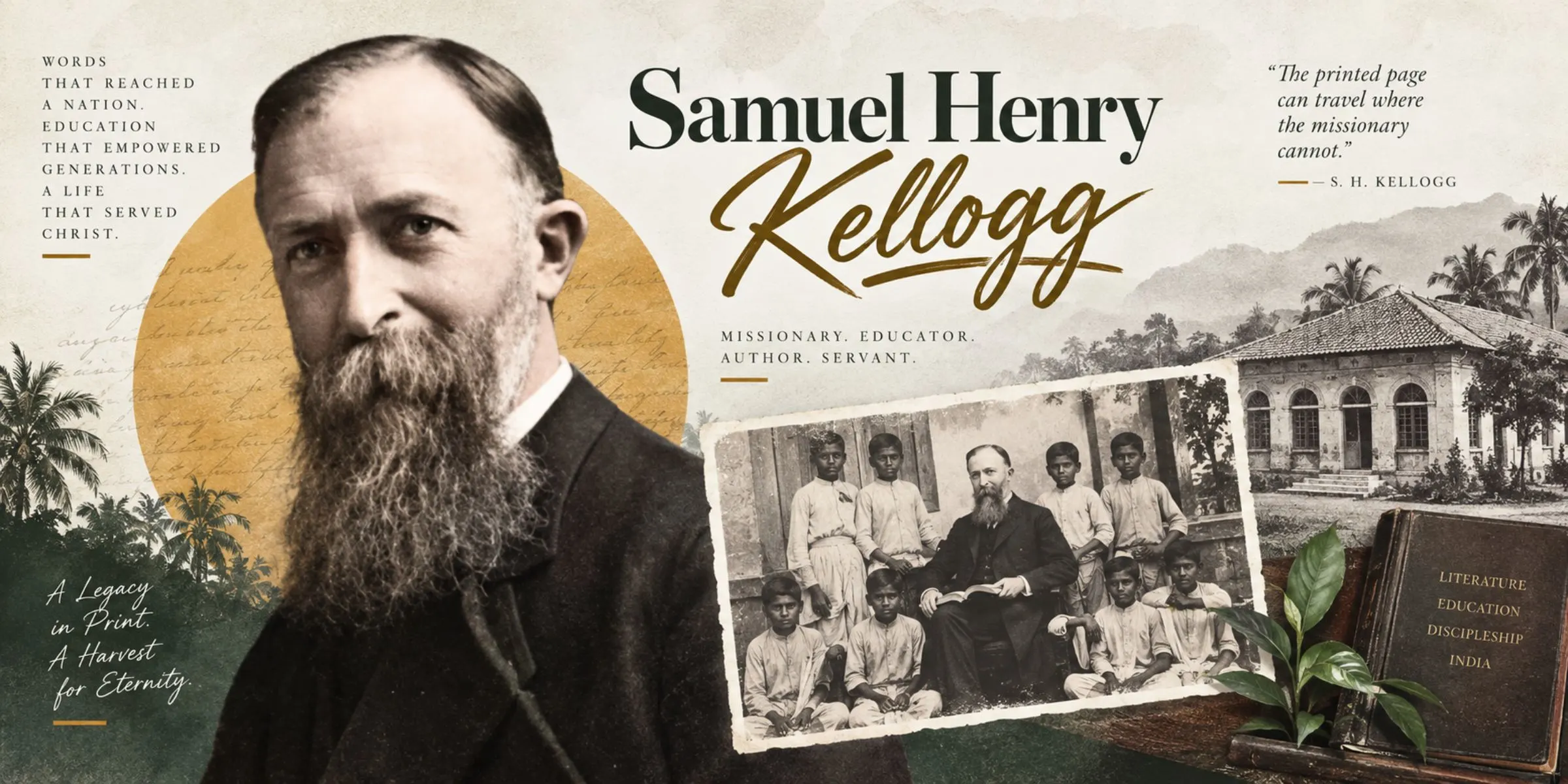
An American wrote the Hindi grammar that Indian Civil Service candidates had to pass their exams on, and it is still in the issue
The standard history of Hindi grammatical scholarship divides itself into periods. One of them is called the Kellogg Era, and it runs from 1876 to 1920.
It is named for an American Presbyterian missionary who arrived in the North-Western Provinces at twenty-five, was left in sole charge of a station outside Farrukhabad with nobody to speak English to, and started taking notes.
The mother with the book
Samuel Henry Kellogg was born in 1839 at Quiogue on Long Island, the son of a Presbyterian minister. He was taught mostly at home. The detail that survives from that house is his mother teaching him Latin while she did the housework, the boy following her from room to room with the book open in his hands.
He lasted one session at Williams College before his health broke. At Princeton he graduated in 1861 ranked joint first in a class of a hundred. His mother died that same year. He finished at Princeton Seminary in 1864, was appointed a tutor in mathematics and was on a clear path to a professor's chair, and instead was ordained for India in April 1864.
A hundred and forty-five days
He sailed from Boston that December on a merchant ship carrying ice to Ceylon. On the third day out the captain was washed overboard in a cyclone. The officer who replaced him could not navigate, the crew began plotting a mutiny, and Kellogg, who had studied navigation, took the daily observations and brought the ship in himself.
The passage was supposed to take a hundred days. It took a hundred and forty-five.
He reached Calcutta in May 1865 and was posted to Barhpur, a station of the Farrukhabad Mission in what is now Uttar Pradesh, eight years after the rising of 1857 had gone through those provinces. He was left in charge alone, with what the record calls a small staff of Hindustani helpers. His own account of it is dry.
It was hard at first, but had the good result of bringing me on in the language much faster than I should otherwise have learned it.
Samuel Kellogg, on being left alone at Barhpur
He was preaching in the vernacular within six months. He began the notes that became the grammar in his first year.
What the book actually did
A Grammar of the Hindí Language was printed at the American Presbyterian Mission Press in Allahabad in 1876. It set out standard Hindi, Braj, and the Eastern Hindi of Tulsidas's Ramayan, and then the colloquial speech of Marwar, Kumaon, Avadh, Baghelkhand and Bhojpur. By the third edition the list had grown to include Magadhi and Maithili.
In his preface he counted what he had done: the declension and conjugation of nine or ten dialects nobody had previously written down, in a language he reckoned sixty to seventy million people spoke across more than two hundred and forty-eight thousand square miles.
The Government of India read it and prescribed it as the authority for every Indian Civil Service candidate required to pass the Hindi examination. It went into a second edition in London in 1893 and a third in 1938. Motilal Banarsidass keeps it in the issue today.
Frances Pritchett, who taught Indian literature at Columbia for decades, puts its continuing use plainly: the comparative grammatical tables are the reason anyone still opens it. If you meet an unfamiliar verb form in early verse, Kellogg is where you go.
He took Indian speech seriously when his colleagues did not
The most striking thing in the preface is how impatient he is with other foreigners.
Europeans of his generation tended to assume that Hindi could be manufactured by taking Urdu and swapping the Persian words for Sanskrit ones. Kellogg had watched them try it. The villagers, he wrote, stared at them confounded by sonorous Sanskrit terms that were less familiar than the Arabic and Persian they had replaced. He pointed out that a purity test strict enough to satisfy those men would disqualify Tulsidas and Kabir.
And in a footnote he refused the hierarchy his own title implied. Calling one form standard, he wrote, is not to suggest the others are corruptions of it. They are collateral branches of the old speech of India, and in most cases older and less changed than the standard itself.
It is not intended to suggest that all other dialectic forms are corruptions.
Samuel Kellogg, on the dialects, 1876
That is why the book is still usable. A grammarian who thought Bhojpuri and Awadhi were degraded Hindi would not have bothered to record their conjugations, and there would be nothing for a student to look up today.
He did not do it alone, and he says so. The work was compiled with pandits, and Indian scholars sat with him through the years of it, supplying the living speech he was writing down.
What it cost
His wife Antoinette died in March 1876, the year the grammar appeared, leaving four children. He broke up the house in India and took them to America, where he stayed fifteen years: a pastorate in Pittsburgh, then a chair in systematic theology at Allegheny.
He lost the chair in 1885. Some of the directors objected that his premillennial views did not sit with the seminary's teaching, and he resigned rather than fight. He went to Toronto instead, where the congregation grew from 503 to 704 under him.
In 1892, after fifteen months of letters from four separate bodies asking him, he went back to India at fifty-three to translate the Old Testament into Hindi.
Three men at Landour
The revision committee was Kellogg, an Anglican and a Congregationalist: W. Hooper of the Church Missionary Society and J. A. Lambert of the London Missionary Society. They worked at Landour above Mussoorie for seven or eight months a year across six hot seasons.
After Kellogg died, the two survivors decided not to appoint a third man. He had left such full notes that they could work from them: on almost every question that arose, they said, they were fairly sure what his view would have been, and when the two of them differed, whichever one's opinion diverged from his gave way at once. They carried the translation to completion.
The books, and a change of mind at the end
Alongside the Hindi work he wrote a commentary on Leviticus for the Expositor's Bible, published the year he died, which conservative preachers still reach for a century later.
He also wrote about Indian religion. The Light of Asia and the Light of the World, published in 1885, was a reply to Edwin Arnold's popular poem on the Buddha, and it is a polemic: the thesis is fixed before the argument begins. What is more interesting is what he thought about it afterwards.
In one of the last letters of his life he set out what he wanted to lecture on next. Hinduism in relation to Christian thought, the Arya Samaj, Brahmoism in its various schools. And he added that this time he wanted to dwell more on the points of contact than of contrast.
More on the points of contact, than of contrast.
Samuel Kellogg, in one of his last letters
He was sixty years old and correcting himself, in a direction most men of his generation never travelled at all.
The bicycle
On 30 April 1899 he preached in the Methodist church at Mussoorie on the text that they shall not die any more. On 2 May he gave the weekly Bible reading at a friend's house, and called in on a sick colleague walking home.
On 3 May his doctor had him cycling for his health. He rode out along the terrace at his house on Landour hill, where there is an unguarded drop of about twelve feet. Nobody saw it happen. The servants heard the sound and found him already dead. He was fifty-nine, and he is buried in the cemetery on the hillside.
Four years later the Kellogg Memorial Church was built at Landour. It is still there.
So what, in 2026?
The grammar outlived the reason it was commissioned. Civil service candidates stopped needing it in 1947. Students of Braj and Awadhi did not, and that is why a book from 1876 is still on a shelf in Delhi with a current price on it.
Most of what people do disappears within a generation. This is a man who arrived somewhere at twenty-five knowing nothing of the language, was left alone with it, and decided that the thing to do was write down how people actually spoke, including nine or ten dialects nobody had thought worth recording.
He was not a linguist by training. He was a mathematics tutor who could have had a chair at Princeton. He got on a ship instead, navigated it himself when the captain went overboard, and spent the next thirty years on somebody else's language.
There is a lesson in there about what a life is for, and it is not a comfortable one. The work that lasted was not the work he was famous for at the time.
Missionary story · Hindi · India · Language