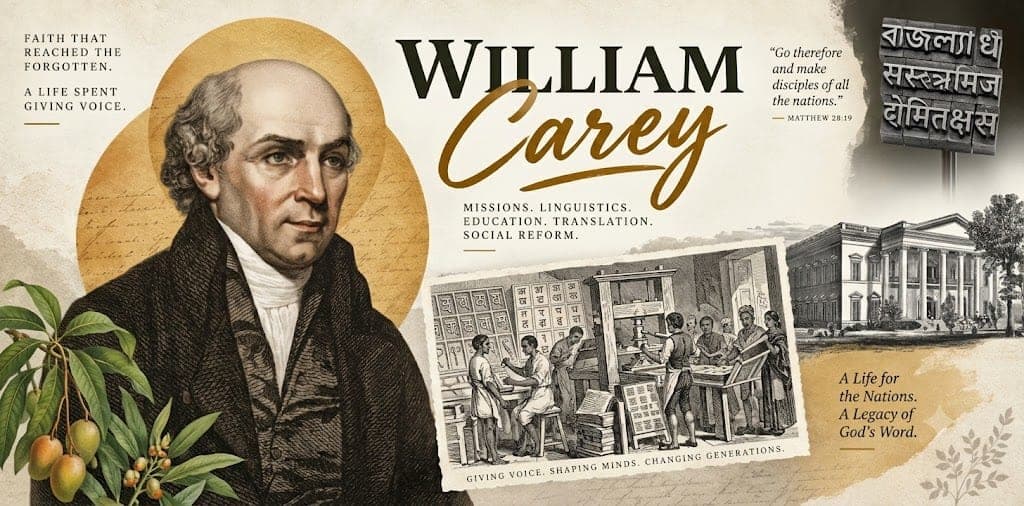
A shoemaker who taught himself six languages, and spent seven years in India without a single convert
He was put to shoemaking because he could not work outside. Sunlight blistered his skin, so a boy from a weaver's family in Northamptonshire was apprenticed to an indoor trade and sat at a bench.
He kept a book open on that bench. By twenty-one he had taught himself Latin, Greek, Hebrew and Italian, and was starting on Dutch and French. He made a globe of the world out of scraps of leather, and marked on it what he could find out about every country: the size, the population, what people believed there.
Somebody called that cottage Carey's College. It was a cobbler's front room.
Paulerspury
William Carey was born on 17 August 1761 in a thatched cottage in Paulerspury, an ordinary Northamptonshire village. His family were weavers and he was not sent to be educated.
At around eighteen he left the Church of England, joined the Congregational church at Hackleton where he was apprenticed, and married there in 1781. He began walking the five miles to Olney and back looking for people who would argue theology with him. Olney was a stronghold of the Particular Baptists, and he was baptised among them in October 1783. Two years later he moved to Moulton to be a schoolmaster, and a year after that became the pastor of its small Baptist congregation.
He was, at this point, a village pastor with no money, no standing and no formal education, who could read six languages.
A book about a sea voyage
What set him off was not a sermon. It was a travel book.
My attention to missions was first awakened after I was at Moulton, by reading the Last Voyage of Captain Cook.
William Carey
Most readers took Cook's journals as adventure. Carey read them as a population census. He started reading everything he could find that bore on the subject, making notes, filling in the leather globe.
When he raised the question at a ministers' meeting — whether the command to teach all nations still bound ministers now — an older man told him to sit down, and that when God chose to reach the nations He would do it without Carey's help. He did not sit down. In 1792 he published An Enquiry Into the Obligations of Christians to Use Means for the Conversion of the Heathens, which surveyed the history of missions, then went country by country through the known world with the size, the population and the religion of each, and then dealt with the practical question of how any of it could actually be done.
It is an odd document to read now. Half sermon, half spreadsheet. The spreadsheet half is why it worked.
That May he preached at Nottingham on what became the sentence he is remembered for: expect great things from God, attempt great things for God. The Baptist Missionary Society was founded at Kettering that October. Carey had no money to put into the subscription and pledged the profits from his book instead.
Serampore
He sailed in 1793. His wife Dorothy did not want to go, and after two returns from the docks to persuade her, she and the children came.
The East India Company would not have missionaries in its territory, so the work ended up at Serampore, a small Danish colony on the Hooghly north of Calcutta, where the Danish governor would have them and the Company could not reach them. The whole enterprise ran for years out of a foreign enclave fifteen miles from British power.
What they built there was a printing house. Carey learned the languages, ran the presses, and by the time he died the Scriptures had been translated and printed in around forty languages and dialects — Bengali, Sanskrit, Marathi, Assamese, Oriya and on down the list. He wrote grammars and dictionaries for languages that had never had one. He printed the first prose books in Bengali, and helped start the first Bengali newspaper. He taught at Fort William College, and in 1818 he and his colleagues founded Serampore College, which was chartered by Denmark to grant degrees and admitted students regardless of caste or religion. It is still open.
He was also, seriously and not as a hobby, a botanist. He kept a five-acre garden at Serampore, corresponded with Kew, published on Indian flora and in 1820 founded the Agri-Horticultural Society of India, arguing that better agriculture was a straightforwardly good thing to give a country. A genus of flowering plant is named after him.
And he campaigned for years against sati, the burning of widows on their husbands' funeral pyres. He collected the evidence and kept putting it in front of the administration. When the practice was finally prohibited in 1829, the edict was handed to him on a Sunday morning to be translated into Bengali. He gave up preaching that day and translated it immediately, so that it could take effect without losing a week.
What it cost
Seven years passed in India before a single Indian person came to faith through their work. Seven years is a very long time to be wrong in public.
In March 1812 the Serampore printing house burned down. It took the presses, the type for a dozen languages, the paper, and the manuscripts — years of translation, including a polyglot dictionary he had been compiling. Work that could not be reconstructed from anything. He began again.
The hardest part of the account is his family. A five-year-old son, Peter, died of dysentery early on. Dorothy — who had not wanted to come, who lost a child in a country she had no wish to be in — became severely mentally ill and remained so for about twelve years until her death in 1807. She is a real cost of this story and she did not choose it. Any honest telling of Carey has to sit with that rather than move past it, and most tellings do move past it.
Why he is still known
He is called the father of modern missions, which is a title that flattens him. What he actually was is a translator, a printer, a lexicographer, a botanist and a college founder, who worked in one place for forty-one years and never once went home on leave.
He died at Serampore on 9 June 1834, aged seventy-two. He had asked that a friend not talk about Dr Carey after he was gone, but about Dr Carey's God.
So what, in 2026?
Somebody once asked what accounted for what he had done. His answer was two words: “I can plod.”
That is a strange thing to read now. Everything around you is built to suggest that the way things happen is fast — that you find the thing, it takes off, and if it does not take off in a reasonable time you were wrong about it. Seven years of no result is not a season anyone plans for.
Carey had seven of them, then a fire that took the work back to nothing, and then he did it again. He was not unusually gifted at any single thing except staying. If you are trying to work out whether to keep going with something slow, he is not an inspiring story so much as a plain piece of evidence: the compounding is real, and almost nobody is around long enough to collect it.
Church history · India · Translation · Lives