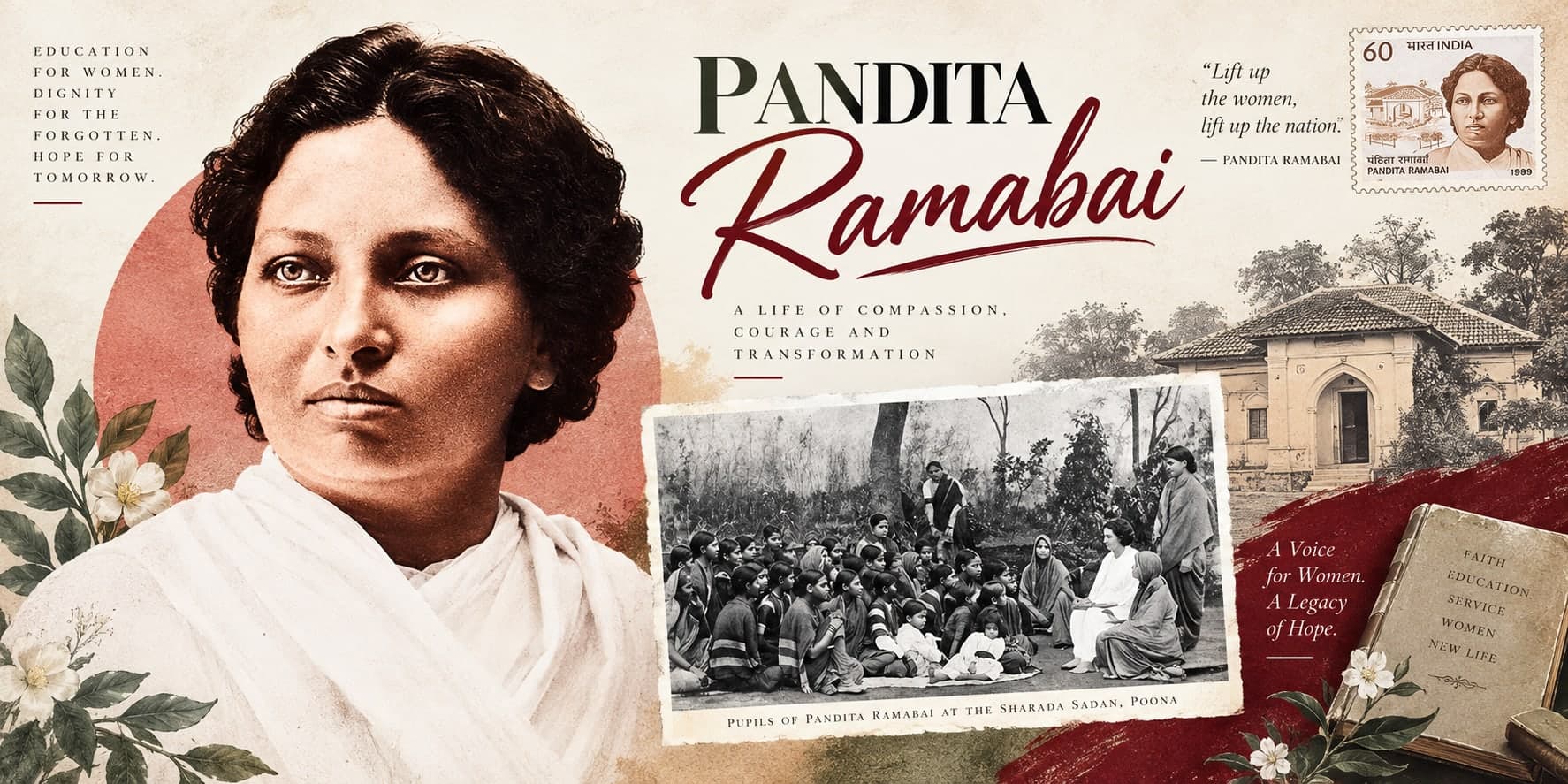
She could recite eighteen thousand verses of Sanskrit, and used it to argue for widows
Her father taught her Sanskrit, which was not done. Girls were not given the sacred language, and men who taught it to their wives and daughters were despised for it. He was, and the family paid for it.
By her twenties she could recite the Puranas from memory in Sanskrit and discuss the grammar. When she reached Calcutta in 1878 the pandits examined her, could not fault her, and gave her the titles Pandita and Sarasvati. She was twenty. It is roughly as if a woman had been handed an honorary chair by the faculty that had spent a century refusing to admit her.
She spent the rest of her life using that authority against the people who had granted it.
A childhood spent walking
Ramabai Dongre was born in 1858. Her father, Anant Shastri Dongre, was a professional reciter — he travelled from village to village performing the epic and mythological texts for people who could not read them, and was paid in donations and gifts by listeners who believed merit came from hearing the words. He had married a nine-year-old girl when he was forty. He taught her Sanskrit too.
So the family walked. Hundreds of miles on foot, from temple to fair to wealthy household, living on what the recitations brought in. They never begged and never took other work. For years it was enough.
Then in 1874 the famine came, and it was not enough. They ate wild leaves and berries. Her father died of hunger, and within months so did her mother, and a sister as well. Ramabai was sixteen. She and her brother Srinivas kept walking and kept reciting, because it was the only trade they had.
Widowed at twenty-three
Srinivas died in 1880. She was alone at twenty-two, and by then she had joined the Brahmo Samaj, the reformist association that was arguing for exactly the things her life had made urgent — women's education, an end to child marriage, the treatment of widows.
In June 1880 she married Bipin Behari Medhavi, a Bengali lawyer. He was of much lower caste than she was, and the marriage was a scandal to everyone who knew her. Their daughter Manorama was born in April 1881. Less than a year later he died of cholera.
At twenty-three she was a high-caste widow with a baby, which in 1882 was among the worst positions a woman in India could occupy. A widow had no place in her husband's house. She was frequently blamed for his death, her head might be shaved, her food restricted, and she could expect to be treated as a household servant at best. Ramabai had spent her adolescence watching girls of eight and nine married off and then abandoned into that.
She had also, some time before, found a copy of the Gospel of Luke in her husband's library, in Bengali, and read it through.
The book that made her famous
She went to Pune, learned English, and started to write. In 1883 she sailed to England — to train as a doctor. That is the detail most retellings leave out, and it is the one that shows what she thought she was doing. She was not going abroad to be looked after. She intended to come back qualified.
She was going deaf, and the deafness ended the medical training. She stayed anyway, studied and lectured on social reform and education, taught Sanskrit at Cheltenham, and in 1883 was baptised at the chapel of an Anglican community at Wantage, whose sisters she had first met in Pune. She had been reading Nehemiah Goreh, an Indian theologian, and had come to the conclusion that what she valued in Brahmo thinking had come from Christianity in the first place.
Then she went to America, and in 1887 published The High-Caste Hindu Woman. It is an unsparing account of what her society did to its girls and widows, and it worked on readers because there was no way to dismiss the author as an outsider who had misunderstood. She had been the woman in the title.
American readers formed an association and promised her ten years of support. Ten years, she said, seemed like a lifetime.
On the founding of the Ramabai Association, 1887
Sharada Sadan, and the rule she made
She came home and opened Sharada Sadan, the House of Learning, in Bombay in 1889, moving it soon after to Pune. It was a school for young widows, and it started with about twenty girls.
Here is the decision that deserves attention. Ramabai was by then a baptised Christian running a school funded by American Christians, and she made Sharada Sadan explicitly non-proselytising. The girls were not required to attend anything. Her supporters at home were nervous about it and her critics never believed it, and she held the line for years regardless.
She thought a widow of fifteen who had been given a bed, food and the alphabet was owed those things without conditions. Whatever else is true about her, she did not use what those girls needed as leverage, at a time when nobody would have stopped her.
Kedgaon
In 1896 and 1897 famine came again to central India. Ramabai, who knew precisely what was happening because it had killed her family, went out into it herself and brought back children — hundreds of them. She had bought land at Kedgaon, outside Pune, and in 1898 she opened Mukti there. The word means liberation.
At its height around two thousand women and girls lived at Mukti. It was not a dormitory. There was a school, a press, a hospital, workshops, oil presses, farmland and a weaving shed, and the older girls were trained first and then put in charge of teaching the younger ones. It was designed to produce women who could earn.
And she translated the Bible into Marathi. Not from an English version — she taught herself Hebrew and Greek in her sixties and worked from the original languages, setting the type at her own press. She was still finishing it when she died.
What it cost
Her health was bad for most of her adult life and much of Mukti's daily running fell to other people. The deafness never left. She was attacked from every direction at once: by orthodox opinion for abandoning her religion and her caste, and by some of her Christian supporters for refusing to convert the girls in her care and for being too Indian in how she ran things.
Manorama, her daughter, the child born in that eleven-month marriage, grew up to help run Mukti and died in 1921 at forty. Ramabai died nine months later, on 5 April 1922, aged sixty-three.
Why she is still known
India put her on a commemorative stamp for her contribution to the advancement of women. She is taught in Indian schools as a social reformer, which she was, and she is claimed by the Indian church, which she also was, and the two accounts of her rarely mention each other.
The Mukti Mission at Kedgaon is still open, and has been for more than a hundred and twenty-five years.
So what, in 2026?
She was extremely good at one specific, difficult, useless-looking thing. She could handle Sanskrit at a level almost no one could, in a language that earned nothing and was withheld from her by custom. She could not have known it would matter.
It turned out to be the whole lever. The scholarship got her the title, the title got her the platform, the platform got her the book, the book got her the funding, and the funding built Kedgaon. A woman with the same convictions and no Sanskrit would have been ignored.
If you are seventeen and being told that what you are good at is impractical, she is a reasonable argument for learning it properly anyway. Not because it will pay. Because when you finally have something to say, the difference between being listened to and being dismissed is usually whether you are undeniably good at something first.
Church history · India · Women · Lives