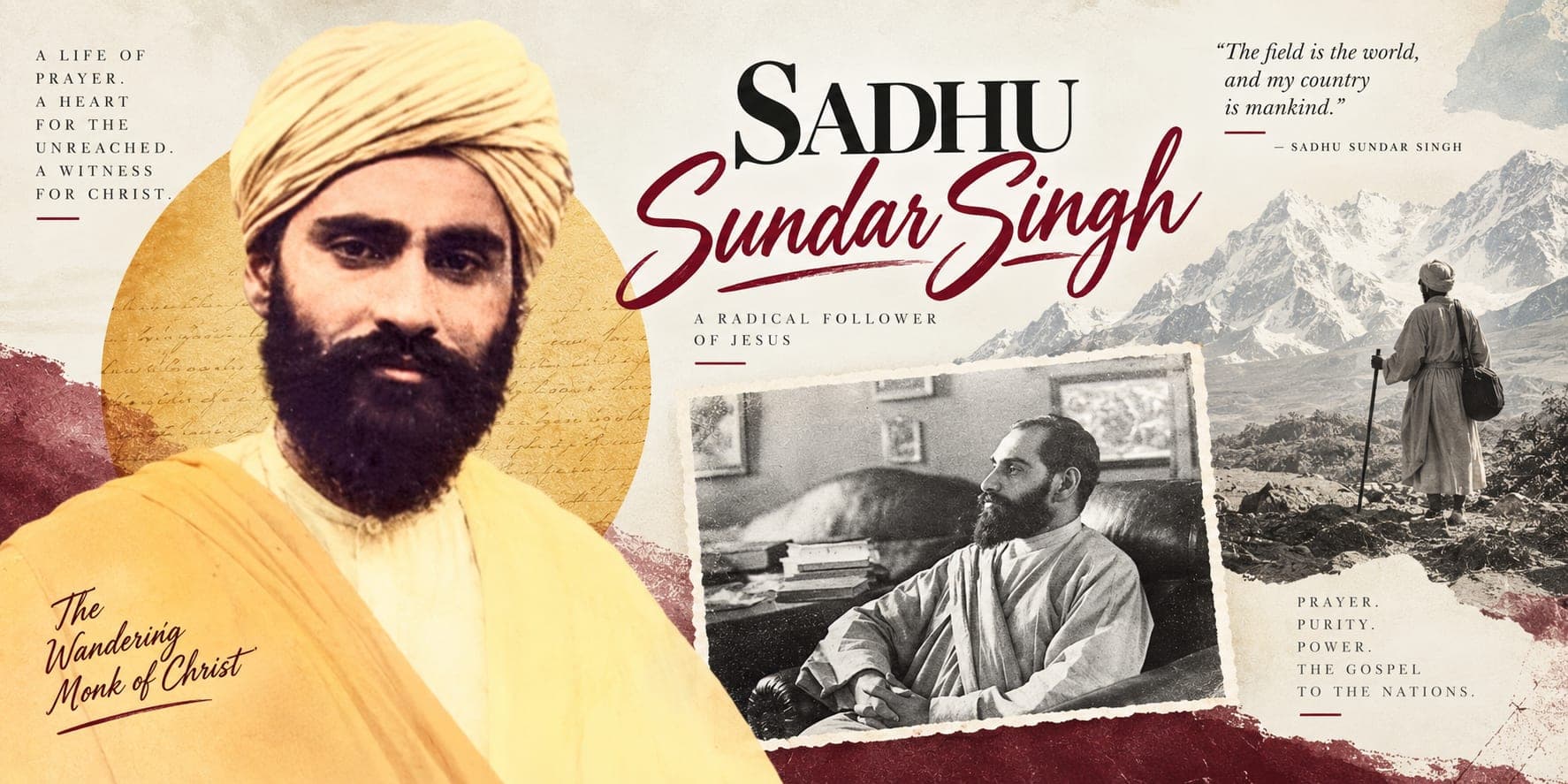
He burned a Bible in front of his father, and three days later would not leave the house without one
He burned it in the courtyard, page by page, where his father and the neighbours could see.
He was fourteen. His mother had died a few months earlier, and he had been throwing stones at the missionaries who preached near his village and disrupting their meetings. Burning the Bible was the loudest thing he could think of to do, and it seems to have frightened even him.
Three days later he decided to lie down on the railway line.
A rich Sikh household in Patiala
His mother took him regularly to a sadhu who lived in the forest nearby, and she wanted him to grow into a holy man rather than a landowner. He was given the Granth to learn, and the Bhagavad Gita, and he read the Vedas and the Quran. By his teens he had a serious religious education by any standard.
He was also sent to the mission school in the village, because it was the school there was — and he hated the Bible lessons. Then his mother died, and the whole structure of his faith came apart at once. He had been looking for peace and had not found it in anything he had been given.
18 December 1903
He had settled on the Ludhiana express, which passed the house in the early morning. The night before, he prayed — for hours, and by his own account not to any god in particular.
O God, if there is a God, reveal yourself to me tonight.
Sundar Singh, aged fifteen
What he described afterwards was a light in the room before dawn, and a figure, and a voice asking how long he would go on denying him. He said he had been expecting one of the gods he had grown up with and instead saw a man with pierced hands.
He went and woke his father to tell him he was a Christian. It is worth holding both halves of that in view: this is a fifteen-year-old who had lost his mother and planned to die that morning, and it is also the account he gave consistently for the rest of his life, to anyone who asked, without embellishment.
His family disowned him. He was, by his own report, poisoned by a relative. He was baptised on his sixteenth birthday in 1905, at the church in Simla.
The saffron robe
A month or so after his baptism he did the thing that made him significant, and it was a decision about form rather than about belief.
He put on the saffron robe of a sadhu. He gave up possessions, took no money, ate what he was given, stayed celibate, and walked.
His reasoning was straightforward and has been quoted ever since: India was not rejecting the water of life, it was rejecting the European cup it was being handed in. A man in a suit with a foreign accent and an institution behind him was, to a village in Punjab, an official of somebody else's empire. A barefoot sadhu with a begging bowl was a category his listeners already had. Same water, Indian cup.
So he walked: Punjab, Kashmir, Rajputana, Baluchistan, Nepal, and repeatedly into Tibet over the passes, which nearly killed him more than once and left him with the frostbite and injuries that earned him the name the apostle with the bleeding feet.
Famous, and uneasy about it
From about 1918 the world came to him. South India, Ceylon, Malaya, China and Japan; then in 1920 Britain, America and Australia; then Europe again in 1922, and Palestine. He preached in Jerusalem, Berlin and Amsterdam. Crowds turned out in numbers that embarrassed him.
He was not comfortable with any of it and said so. He kept the robe on in London, refused most of what was offered, and went home.
From about 1922 his health was failing and he wrote instead — short books, direct and plain: At the Master's Feet, Reality and Religion, The Search After Reality, Visions of the Spiritual World.
What is disputed
An honest account has to include this. In the 1920s a group of European critics, mostly in Germany and Sweden, went through his accounts of miracles and of his imprisonment in Nepal and argued that some episodes could not be corroborated and that dates did not always agree. The argument ran for years and was not settled.
What was never seriously disputed by anyone, including his critics, is the rest of it — that he gave away everything he had at sixteen, that he walked into Tibet again and again knowing what it cost, and that he did not profit from any of it.
1929
In April 1929, against advice and in poor health, he set out for Tibet again. He was last seen heading up the road beyond Badrinath, into the mountains.
He did not come back. Friends went up the trail after him and found nothing. Nobody knows what happened. He was thirty-nine.
So what, in 2026?
The interesting thing about him is not the vision. Plenty of people report visions and it changes nothing outside their own heads.
The interesting thing is that at sixteen he identified the actual obstacle. It was not that people disagreed with him. It was that the form the message arrived in made it unhearable — foreign, institutional, attached to power. So he changed the form and kept the content, and it cost him everything he owned.
That question has not aged at all. Whatever you care about, some of the resistance you meet is disagreement and some of it is packaging, and telling the two apart is most of the work. He is worth reading because he got that distinction right at an age when almost nobody does.
Church history · India · Punjab · Lives