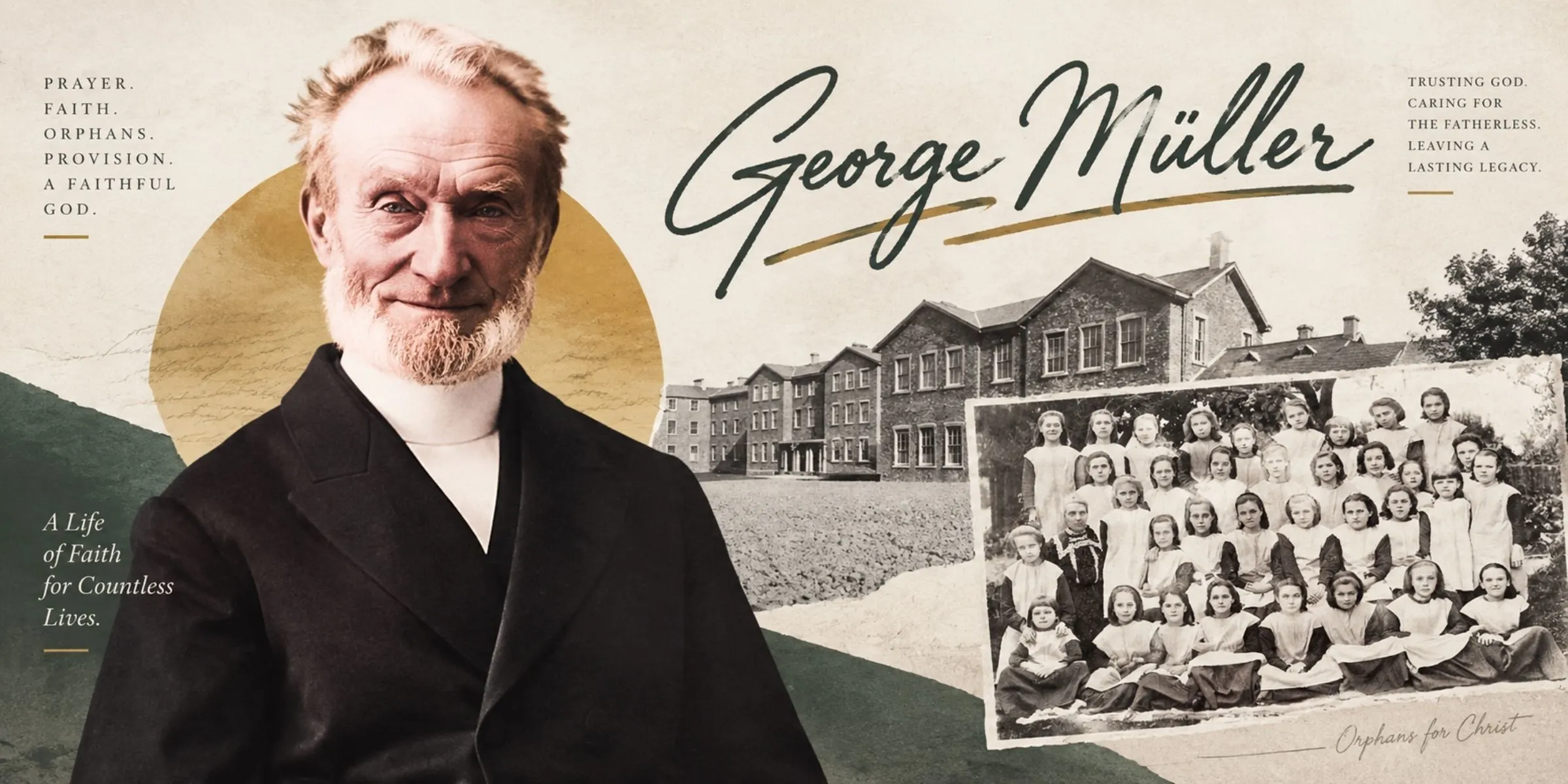
He fed two thousand children a day and never once asked anyone for money
By the age of ten, George Müller was stealing government money from his father, who was the tax collector. He was good at it. When his father grew suspicious and laid out a marked sum to catch him, Müller found the trap, took part of the money, and hid the rest in his shoe.
At fourteen he was playing cards in a tavern and drinking while his mother lay dying a few streets away. He found out the next morning, walking home.
Sixty years later, five houses on a hill in Bristol were feeding, clothing and schooling around two thousand children at a time. Over his lifetime he cared for 10,024 orphans. He never once asked anybody for a donation.
A boy being trained for a job he did not want
He was born in 1805 in Kroppenstädt, a village in what was then Prussia, and grew up in Heimersleben, where his father collected taxes. His father's ambition for him was specific and entirely financial. The state church paid its clergy well, so George would be a clergyman. He was sent to study divinity at Halle with that in view.
He describes those student years without any softening. He was a thief, a liar and a gambler. He ran up debts, took money from friends on stories he had invented, and was once jailed for skipping out on hotel bills. He had no Bible. He had not read scripture in years. He took communion twice a year out of habit and heard nothing preached that he could remember.
He was, in other words, exactly the kind of person the respectable version of this story would leave out.
The evening in somebody's front room
In 1825 a fellow student named Beta mentioned that a group met in a private house on Saturday evenings to read the Bible, sing, and pray. Müller went, mostly out of curiosity. What struck him was not a sermon. It was watching a man kneel down on the floor to pray.
In his own account of it, written years afterwards, he is careful not to overstate what he understood at the time:
I have no doubt that He began a work of grace in me. Even though I scarcely had any knowledge of who God truly was, that evening was the turning point in my life.
George Müller, Autobiography
He went home, knelt by his own bed and asked for help. The drinking, the stealing and the lying stopped. His father, who had paid for an education meant to produce a comfortable salary, was furious when it became clear his son intended to give the salary away.
Refusing to be paid
Müller moved to England in 1829 and settled into pastoral work in Devon, and then in Bristol, where he stayed for the rest of his life. Two decisions from those first years explain everything that followed.
He gave up his salary. He had been on £55 a year at a chapel in Shaldon, and he concluded that a fixed wage collected from the congregation made people give out of obligation rather than because they wanted to. So he stopped taking it and lived on whatever came in unasked.
He also abolished pew rents. Churches at the time sold the good seats, which meant the moneyed families sat at the front by arrangement. Müller read James 2 — the passage about showing deference to the man in fine clothes — decided the practice could not survive it, and ended it.
Neither decision cost him much yet. Both were about to be tested at scale.
Thirty girls, then two thousand children
The orphan work began in 1836 in his own rented house at 6 Wilson Street, Bristol, prepared for thirty girls. Three more houses on the same street followed, and the number in his care reached 130.
By 1845 the neighbours had had enough of the noise and the strain on the street's water supply, and Müller decided to build. The first purpose-built house at Ashley Down opened in 1849 for three hundred children. Four more followed. By 1870 there were 1,722 children living on that hill with room for over two thousand.
The buildings cost more than £100,000, an enormous sum in the 1850s. He never launched an appeal, never wrote to a wealthy man asking for a contribution, and never borrowed. When he needed something he prayed for it and waited, and if it did not come he did not do the thing.
The most famous morning at Ashley Down is famous because it was documented rather than remembered. The children were at the table for breakfast and there was no food in the building. Müller gave thanks for the meal anyway. As they finished, the baker knocked — he had been unable to sleep and had got up at two in the morning to bake for them. Then the milkman's cart broke down directly outside and he handed over his milk rather than let it spoil.
There are hundreds of entries like it in his journals, because he wrote every one of them down as it happened.
The receipts
This is the part that gets left out of the inspirational version, and it is the part that makes the rest credible.
Müller kept accounts obsessively and published them. Every gift was recorded: a single farthing, £3,000, an old teaspoon. He printed his receipts with a standing instruction to the donor:
Donors are requested, kindly to keep the receipts and to compare them with the Supplement to the Report, which records every donation received, so that they may be satisfied that their donations have been properly applied.
Printed on Müller's donation receipts
He was inviting every person who gave him a coin to audit him. The books were open for anyone to inspect and the annual reports listed every transaction. Over his lifetime the institution received and spent £1,381,171, somewhere near £113 million in today's money, and he wanted every line of it checkable.
His own income, all of it unsolicited, reached over £2,000 a year by 1870. He kept about £300 and gave the rest away. He died with an estate of a hundred and sixty pounds, most of it the value of his furniture.
What it cost
Mary, his wife of thirty-nine years and the person who actually ran the orphan houses day to day, died in 1870. He preached at her funeral himself.
He was not universally admired. He was accused of raising poor children above their station. The complaint was that he educated them too well, and that nearby factories and mines could not get workers because he kept finding the children apprenticeships and trades instead. He employed an inspector to keep the teaching standards up. Every child left with a Bible and a tin trunk holding two changes of clothing.
He also spent years inside a bitter split in his own movement. When the Brethren divided in the 1840s, Müller took the position that people should not be excluded for associating with someone whose doctrine was disputed. John Nelson Darby, leading the other side, called on him in July 1849 to talk it over. Müller had appointments and could give him ten minutes. Ten minutes was not enough, and the two men never met again.
Why he is still known
He travelled more than 200,000 miles after he turned seventy, preaching in English, French and German across Europe, America, Australia, India, China and Japan. He returned to Bristol and died there on 10 March 1898, in one of the orphan houses. Ten thousand people came to the funeral, fifteen hundred of them children from the homes he had built.
His biographer William Henry Harding thought the world had got him wrong even then, and that people preferred to remember a kindly old gentleman who was fond of children, which was a way of not having to deal with what he actually claimed. The orphanages were never the point to Müller. They were the evidence.
The work continues. The George Müller Charitable Trust still operates in Bristol and still refuses to fundraise.
So what, in 2026?
Almost everything now runs on asking. Creators ask for subscriptions, charities run campaigns, startups pitch, and every app you open is engineered to request something from you. Asking is not wrong. But it is so completely normal that a man who built a £100,000 institution and refused to send a single appeal letter is genuinely difficult to categorise.
The interesting thing is not that he trusted God for money. Plenty of people say that. It is that he built an audit trail so anyone could check whether it had worked — and then published it for sixty years. He was making a claim that could have been falsified at any point, in public, by a bookkeeper.
That is a rarer kind of confidence than the loud kind, and it is worth more. If you are wondering what to do with what you have, the question Müller kept answering was not how much can I raise. It was: can anyone look at my books?