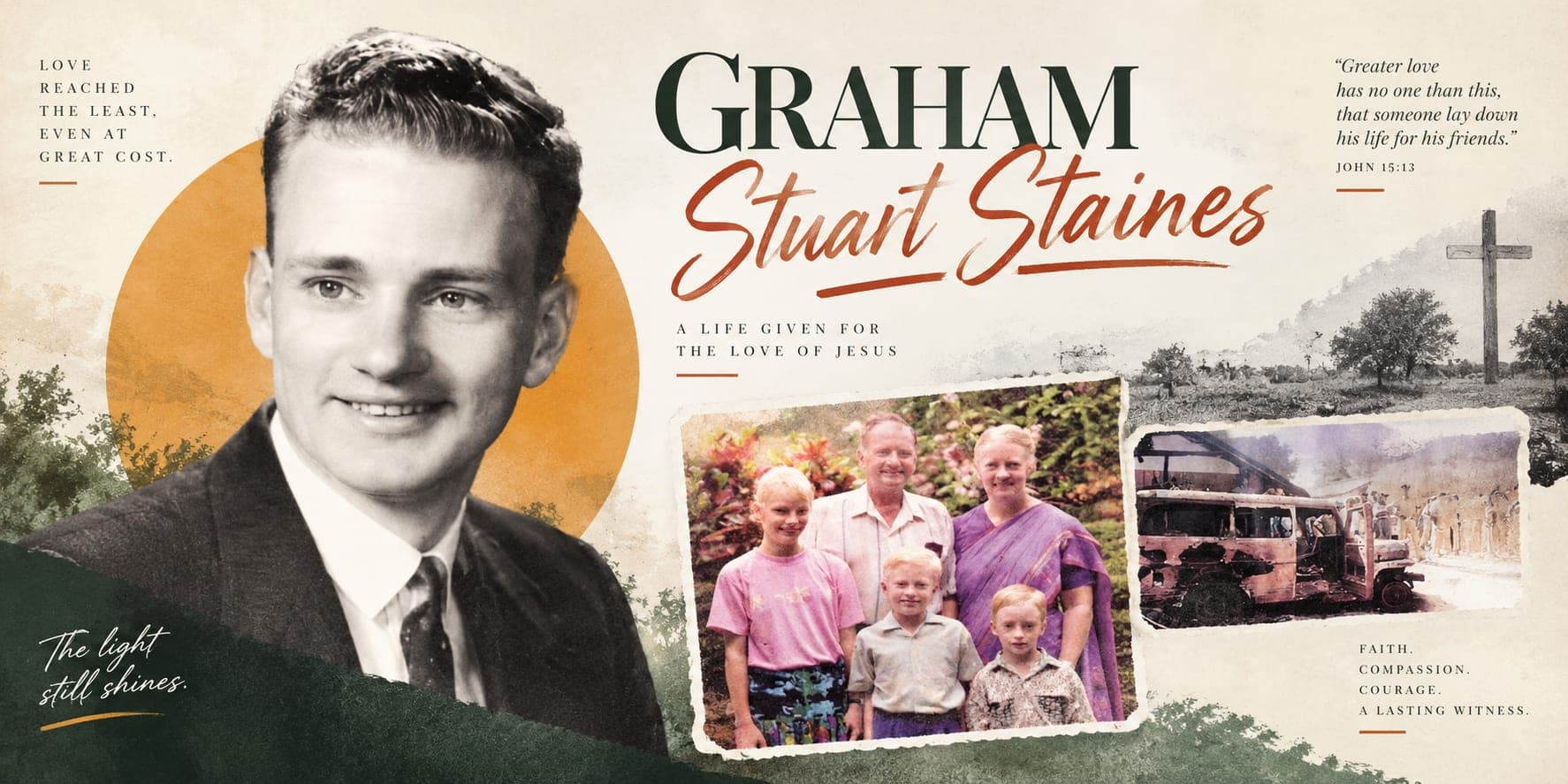
He saw a photograph of a boy his own age with leprosy, and gave India the next thirty-four years
He was fifteen, sitting in a hall in Queensland while a visiting missionary showed photographs. One of them was of a boy in India called Josia Soren, about his own age, with severe leprosy.
Graham Staines could not explain afterwards why that particular picture would not leave him alone. Two years later, at a missions meeting, a speaker asked whether anyone in the room would go and work among people with leprosy. He said yes.
He arrived in India on his twenty-fourth birthday and stayed thirty-four years.
A boy in Palmwoods with a pen friend
He was born on 18 January 1941 in Palmwoods, on what is now Queensland's Sunshine Coast, the second child of William and Elizabeth Staines. He did well at school, then took a job in the office of a local garage and went to night classes to learn accountancy. He was heading for an ordinary and comfortable Australian working life.
In 1956 he began writing to a pen friend in India. Shantanu Satpathy lived in Baripada, the district town of Mayurbhanj in Orissa, and the two boys turned out to share a birthday. They wrote to each other about the plants and animals of their two countries. Long before he ever saw the place, Baripada was a real town to him with a real person in it.
That is worth pausing on. The photograph gave him the need. The letters gave him the address.
Three languages, and a song about polio
He went out in 1965 and joined the Evangelical Missionary Society of Mayurbhanj, which has a founding story that is not the one people expect. It was started in 1895 by Kate Allenby of the Queensland Baptist Missionary Society, at the invitation of Sriram Chandra Bhanj Deo, the Maharaja of Mayurbhanj, who had asked for it.
Staines learned Oriya, then Santhali, then Ho. He got good enough at Santhali that the local administration asked him to write a song in it to help publicise a polio immunisation drive. He wrote the song.
Years later he was still at it, handing out leaflets for the Pulse Polio campaign while Gladys drove the station wagon at the head of the awareness procession. He was president-designate of the Baripada Rotary club. None of that is mission work in the narrow sense. It is what happens when someone decides a town is theirs.
People knew the Australian on the bicycle in the sun hat. They called him Saibo.
The leprosy home
In 1982 he got the Mayurbhanj Leprosy Home registered as a society under Indian law, and in 1983 he took over running the mission. Those two administrative acts are the whole of his method: he made the thing legal, permanent and inspectable, and then he ran it.
The home housed and treated somewhere between seventy and a hundred people at a time. Leprosy in rural Orissa in the 1980s was not primarily a medical problem. It was a social one. A diagnosis meant being put out of your village, and the disease carried an untouchability that outlasted the cure by years.
So the work was not only bandaging. Patients whose disease had been arrested were taught to weave mats and baskets from sabai grass and tree leaves, so they had a trade to go back with. That mattered more than it sounds: a cured patient with no income was a cured patient who would be turned away twice, once for the disease and once for the begging.
When somebody recovered and still had nowhere on earth to go, Staines found them a place inside the compound. Ten families ended up living in the rehabilitation community. Two compounds, a farm, and around twenty-seven churches across the district had grown up around the work by the end.
He wanted more. His ambition was to build the centre into a full hospital, so that patients needing reconstructive surgery would not have to travel for it.
The dairy
The detail that says most about the work is the milk.
The mission ran a dairy farm, and its milk sold well in Baripada. Think about what that means. People who would not have shaken hands with a leprosy patient were buying milk from a farm attached to the leprosy home, and thinking nothing of it.
That is stigma being dismantled by ordinary commerce, and it does not happen by accident.
On the Baripada dairy
Somebody had to decide the farm was worth running, keep the quality up, and wait for the town to forget what it had once believed about the people living up the road. That is years of unremarkable decisions producing a result no campaign could have produced.
The night of the fire
A fire tore through Baripada and left around a hundred people dead and many more badly burned. The local hospital could not cope with the numbers.
Graham and Gladys spent the nights nursing the injured. He was a mission administrator with an accountancy background and she was a trained nurse, and when the town needed hands they were simply there, doing it, for as long as it took.
The Ho New Testament
The Ho are an indigenous people of eastern India, and their language had no complete New Testament. Staines worked as an editorial checker on the translation, going through the manuscript against the original text. It was published in 1997.
It is unglamorous work of the kind that lasts. A translation stays in use long after the person who proofread it is forgotten. He had a reputation as a compelling preacher, but the book is the object that outlived him.
Gladys Weatherhead had arrived in 1981, a trained nurse from Ipswich in Queensland who came out on a short youth mission and volunteered at the centre. They married in 1983 and lived in an old house in the mission compound. They had three children: Esther, Philip and Timothy.
1999
On the night of 22 January 1999, Graham Staines and his two sons, Philip and Timothy, were killed at the village of Manoharpur when a mob set fire to the van they were sleeping in. Philip was ten. Timothy was six.
In the inquiry that followed, allegations that Staines had coerced anyone into changing religion were examined and found to be unsupported by evidence. Gladys has rejected them too.
What Gladys said
Gladys Staines gave evidence to the commission that inquired into the deaths of her husband and her two sons. This is from her affidavit:
It is far from my mind to punish the persons who were responsible for the death of my husband Graham and my two children. But it is my desire and hope that they would repent and would be reformed.
Gladys Staines, affidavit to the commission of inquiry, 1999
She did not leave. She stayed in Orissa and kept the leprosy work running for another five years, and went home to Queensland in 2004. In 2005 the Government of India gave her the Padma Shri. She still serves as honorary secretary of the mission society, from Townsville.
What is there now
A hostel for forty boys named after Philip and Timothy opened in 2003. A fifteen-bed hospital named after Graham opened in 2004, which is the hospital he had wanted, finished after he was gone. A girls' care centre named after Kate Allenby, who started the mission back in 1895, opened in 2013.
None of it has been smooth. The hospital suspended its activity in 2019 after a dispute with the state government. This is not a story that resolves neatly, and it would be dishonest to write it as though it does.
Every January, around fifty Christian families at Manoharpur gather outside the small church there to pray and remember. They still call him Saibo.
So what, in 2026?
Almost nothing he did would work as content. He learned three languages, which took years and produced no visible milestone. He filed the paperwork to register a leprosy home as a society, which is the least shareable act imaginable and is also the reason the place survived him. He proofread a New Testament in a language most Indians have never heard spoken. He sold milk until people stopped flinching.
There is no moment in any of that. There is no before-and-after. It is thirty-four years of turning up in the same town.
If you are seventeen and wondering what a life spent on something actually looks like, it looks less like a decision and more like an address. One photograph, one pen friend, one town you keep going back to until you know its languages. He was fifteen when he saw the picture. He was twenty-four when he arrived. In between, he learned accountancy and waited.
Church history · Odisha · Leprosy · Lives