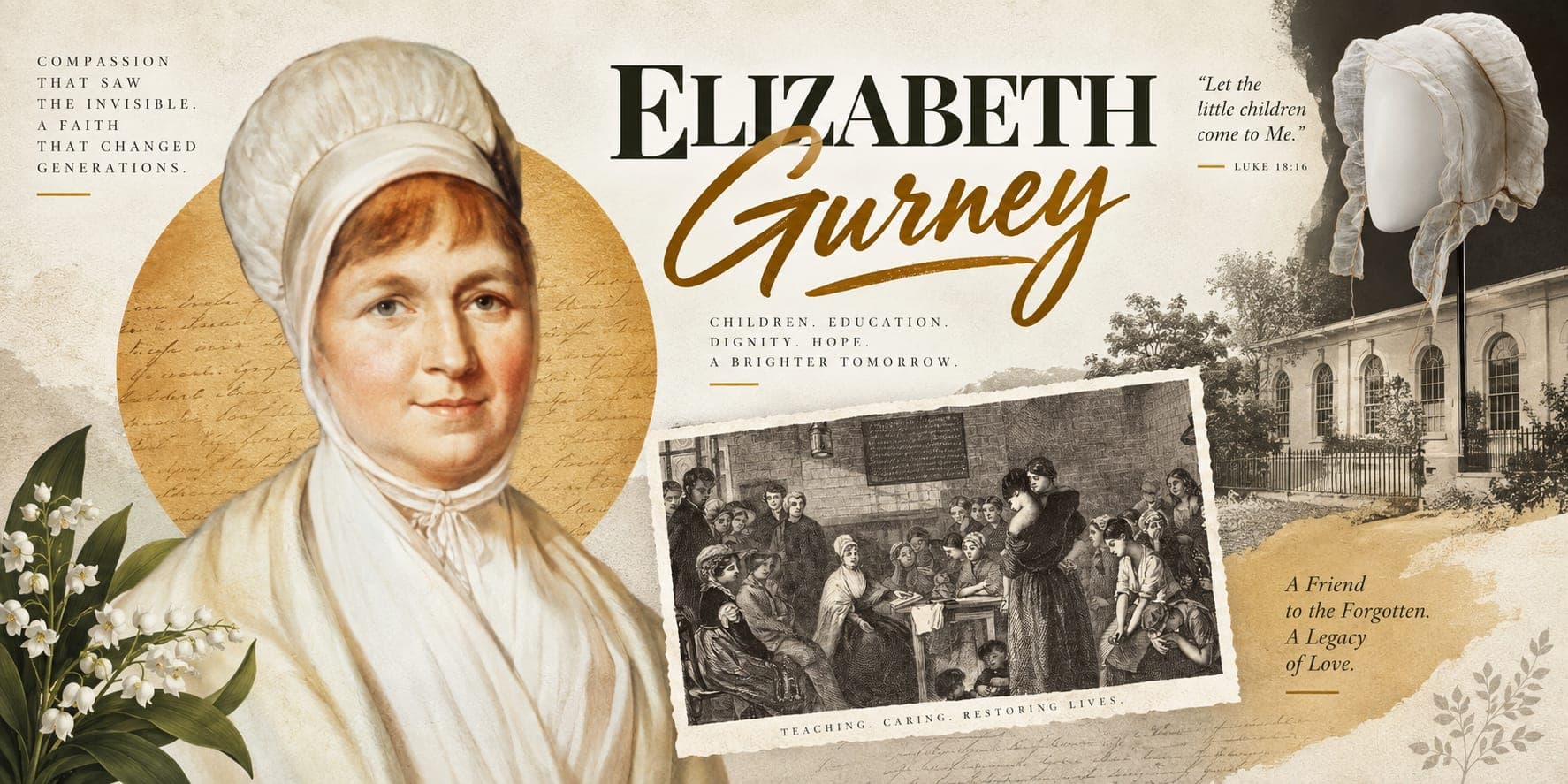
She walked into Newgate against advice, and found three hundred women sleeping on stone
The governor of Newgate told her not to go in. He said the women were dangerous and that he would not be responsible for what happened to her.
She went in. Inside were around three hundred women and their children in two wards, sleeping on stone with no bedding, cooking and washing and sleeping in the same space, many of them not yet tried for anything. She took off her watch first, so that nobody would be tempted.
She was a banker's wife from Norwich with a houseful of children, and she came back the next day.
Purple boots with scarlet laces
Elizabeth Gurney was born on 21 May 1780 into a wealthy Quaker family in Norwich; her father was a partner in Gurney's bank. It was money, but it was money attached to an unusually strong sense that you were answerable for what you did with it.
As a girl she found Quaker meetings dull and said so. She liked clothes, and she is remembered by her family for a pair of purple boots with scarlet laces, which is not the standard costume of a Quaker teenager. She was not obviously heading anywhere serious.
In 1798, at eighteen, she heard an American Quaker named William Savery preach in Norwich, and something in it caught. She began visiting the poor, collecting clothes, and running a small school for local children in her own home. Two years later she married Joseph Fry, a tea merchant and banker, moved to London, and over the next twenty-two years had eleven children.
For thirteen years she was, from the outside, an ordinary well-off Quaker wife with a very large family.
1813
In 1813 a family friend came back from Newgate and described what he had seen: women and their babies on bare floors, no clothes, no doctor. She collected clothing, and went.
What she did afterwards is the part worth studying, because it was not charity. It was organisation.
In 1817 she founded the Association for the Improvement of the Female Prisoners in Newgate. It set up a school inside the prison for the children, and then for the younger women. It appointed a matron. It brought in paid needlework so the women earned something. And it drew up a set of rules — which the women themselves discussed and voted on.
That last detail is the whole method. She treated women whom the law had written off as capable of running their own affairs, and it worked well enough that officials came to look at it, and then to copy it.
The first woman to give evidence
In 1818 she was called before a committee of the House of Commons to give evidence on the state of the prisons. She was the first woman to do it.
She kept at it for decades: travelling the country and then Europe inspecting prisons, writing, and pressing officials. Her work fed directly into the reforms of the 1820s, including the Gaols Act of 1823, which required prisons to be inspected, women prisoners to be supervised by women, and gaolers to be paid rather than living off fees extracted from the inmates.
She also went to the convict ships. Women were transported to Australia for very small thefts, and were loaded aboard in irons. She got the irons stopped, and made sure each woman went with a bag of useful things: needles, thread, and cut patchwork pieces. The point was not sentiment. A woman arriving in New South Wales with a finished quilt had something to sell and a demonstrable skill, which is the difference between starting again and stealing again. One of those quilts, made aboard the ship Rajah in 1841, survives in Canberra.
She started a night shelter in London after seeing the body of a boy who had died in the street. She organised libraries for coastguard stations. And in 1840 she opened a training school for nurses — whose nurses Florence Nightingale later took with her to the Crimea.
What it cost
In 1828 her husband's bank failed. The family were ruined, Joseph was declared bankrupt, and the Society of Friends disowned him over it. Her brother had to step in. For a woman whose public standing rested partly on being unimpeachable, this was a humiliation carried out in public, and it curtailed her work for a period.
There was criticism of a more personal kind too, and it should be recorded rather than waved away. She was a mother of eleven who spent a great deal of time away from her own household doing this, and some of her children felt it. Several of them left the Quakers. Whether that is a charge or simply the arithmetic of one life is for the reader, but the arithmetic is real.
And she had public opponents. Members of Parliament argued that she was making prison comfortable and destroying its power to deter. That argument has not gone away in two hundred years.
Why she is still known
She died at Ramsgate on 12 October 1845. She had become, by some accounts, the best-known woman in England after the Queen. Between 2002 and 2017 her face was on the Bank of England five-pound note.
The system she argued for — that prisons should be inspected, that women should be supervised by women, that a prisoner is a person rather than a thing to be stored — is now so ordinary in Britain that nobody thinks of it as anyone's idea.
So what, in 2026?
The interesting thing about her is not that she was kind. Plenty of people were kind to prisoners and changed nothing at all.
What she did was build an organisation, put a matron in place, set up a school, arrange paid work, hand the women a vote on their own rules, then take the evidence to Parliament and repeat it for thirty years. She turned a feeling into a structure, and the structure outlived her by two centuries.
That is the harder half, and it is the half that usually gets left out of the story. If something makes you angry, the useful question is not how strongly you feel about it. It is what you would actually build, who would run it when you are not there, and whether you are willing to spend thirty years saying the same thing to people who are not listening yet.