Why we built a devotional app in three languages
This section exists to ask what technology costs as well as what it gives. So it is an awkward place to begin with an app made by this magazine's own editor, and rather than pretend otherwise we have put the disclosure at the top where you cannot miss it.
We are running it anyway, for one reason. Almost every conversation about Christians and phones in India is either a warning or an advertisement. Very little of it is someone explaining what they actually built, what they decided not to build, and what they are still unsure about. That conversation is worth having, and the honest way to start it is with something we cannot hide behind.
Two questions below are the ones we intend to put to every app and product we cover. Whether the thing is designed to be finished and closed, or to keep you there. And whether it turns faith into a score. The answers are the maker's own. Readers are welcome to judge them.
What is Daily Devo, in one sentence?
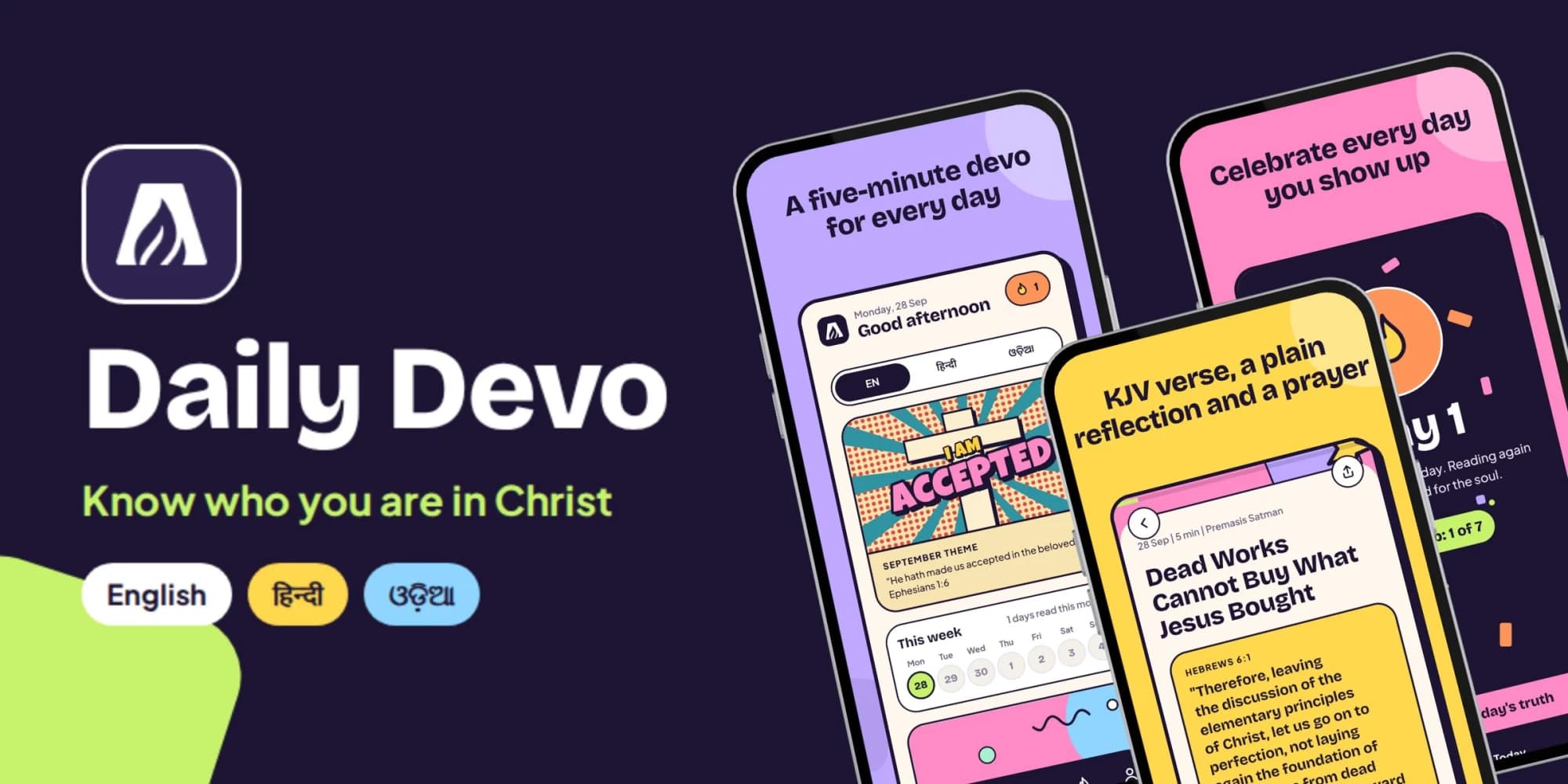
One short devotional a day on your phone: a King James verse, the same verse in plain English, a short reflection, and a prayer, in English, Hindi or Odia.
The tagline is know who you are in Christ, and that is the whole of it. Every reading points back to one thing: who you already are. Chosen, loved, accepted, forgiven. Not what you should become if you try harder.
There are already big Bible apps. Why build another one?
The big apps are wonderful and I use them. But most daily devotionals are long, and most are in English only.
In India a great many people read English for work and pray in Hindi or Odia. Those are not the same language in a person's head. We wanted something small enough to finish before college or the office, in the language people actually think in.
Why keep the King James Version?
Because many of our readers grew up with it, and its words carry weight in our churches. A verse in the King James is the verse their grandmother would recognise.
But that old English shuts younger readers out, and pretending otherwise helps nobody. So every verse is followed by a plain English reading. You get the verse you would hear in church, and you understand it on the bus.
How did you handle Hindi and Odia?
The whole app switches language, not only the devotional. Menus, reminders, everything. You can also read the devotional in one language while the app itself is in another, which people do more than we expected.
Translation was the hardest part by a distance. A word like grace does not land the same way in every language, and a literal translation can be accurate and still be wrong. So every line is read by a native speaker before it goes out. We are still learning, and we still get things wrong.
Who is it for?
Mostly young people, thirteen and up, and especially people in their twenties.
The design is bright and playful on purpose. Each month has a theme and a pop-art poster, like I am accepted from Ephesians 1:6. We wanted it to feel like something a young person would open, rather than something they would be told to open. Those are different products.
Apps are built to keep us scrolling. Is a devotional app not part of the problem?
It can be, and we thought about this more than any other question.
Daily Devo is meant to be finished in five minutes and closed. There is no feed. There is no endless content waiting below. When you are done, the app tells you that you are done, which is a sentence almost no other app on your phone will say to you.
The app has streaks and a 7/7 Club. Does that not turn faith into a scoreboard?
That was the risk we worried about most, and I am not certain we have solved it.
What we did: there are no rankings and no leaderboard against other people. The 7/7 Club simply marks a week where you read every day, and it resets every Monday, so nobody is ahead or behind. Grace days cover the busy ones. If you miss a day the app welcomes you back and nothing is lost.
That last part matters more than the badges. We wanted the app to behave the way grace behaves. Whether a streak can ever fully escape being a score, I genuinely do not know.
Is there a risk that people read the app instead of the Bible?
Yes, and I want to say this as plainly as I can, in print, where it cannot be softened later.
Daily Devo is not a substitute for the Bible. It is not meant to be, and if it becomes one for you, close it and open your Bible instead.
Five minutes of somebody else's reflection is not the same as sitting with Scripture yourself. Every reading in the app carries a verse precisely so that the verse is the thing you take away, and if a reader finishes a devotional and never opens the book it came from, then the app has failed at the one job it was built for.
I would rather lose readers than be a comfortable replacement for the thing itself. A devotional is a doorway. It is not the room.
You are a pastor, and you write software. Which came first?
The software. I was building things long before I was preaching, and for years I kept the two in separate rooms in my head. The work paid for the ministry. That was the arrangement, and I suspect a great many Christians in technology have the same one.
Did you ever think you would have to choose between them?
Yes, for a long time. I assumed that being serious about God would eventually mean leaving the work behind, that going properly into ministry meant going out of technology.
What changed it was noticing that nobody had ever asked me to choose except me. And that the things I could make were things nobody else in my church could make. That is not a small thing to have been handed.
In 2013 somebody took your website. Technology cost you the magazine once. Now you build with it. How do you hold both?
That is the right question to ask me, and it is not a comfortable one.
Our old site was hacked and we lost it. The magazine had already become hard to carry for other reasons, and that was the push. So yes, the first serious thing technology did to this work was take it away.
What I would say now is that the thing which broke it was also the only thing that could bring it back. The archive exists again because it could be rebuilt. Issues that were sitting in PDFs nobody could find are now pages a person can search for at two in the morning. The same tool did both. That is usually how it goes, and it is why this section is supposed to ask what technology costs as well as what it gives.
Most of our readers will never build anything anyone would call Christian. They write insurance software in Chennai. What does their work have to do with the Kingdom?
More than they have been told, and I say that as someone who believed the opposite for years.
Nobody in my church could have built this app. That is not a boast, it is just true, and the reverse is equally true: I cannot do most of what they do. The skill you have is unevenly distributed on purpose. If you can make a thing that helps people and you do not make it, the gap stays open and somebody else's grandmother keeps not being able to read a devotional in Odia.
It does not have to be an app. The point is that the ability is the assignment. You do not need to leave your desk to find out what God wants; quite often the desk is the answer.
What do you actually want PS.Today to be?
Smaller than people expect, and more useful.
I do not want a platform. I want a person in Jharkhand or Odisha or Andhra to open their phone, read one thing in their own language, understand it, close the phone, and get on with the day. If that happens for a few thousand people every morning for years, that is the whole vision. There is no second act I am holding back.
What I would like is for somebody reading this to build the one for a language we have not reached. There are hundreds and we will never get to most of them.
What about privacy?
You do not need an account to read. Open it and start.
If you do sign in, we keep only what the app needs, we do not sell or share it, and there are no ads. Points and badges are never exchanged for money, gifts or prizes. Anyone can delete their account and their data at ps.today/delete-account, in the app or on the web.
Readers aged thirteen to seventeen join with a parent or guardian's consent, and their names are never shown in the 7/7 Club.
What is next?
Listening. It is on Android now, and we will decide about iPhone based on who asks for it rather than on principle.
What I would most like is to hear from readers of Hindi and Odia about what reads naturally and what does not. That is the part we cannot get right on our own.
Where can people find it?
Daily Devo is on Google Play. Search for Daily Devo by PS.Today.

5Talents
Written by the 5Talents editorial desk.
Translation · Bible · Apps · Technology