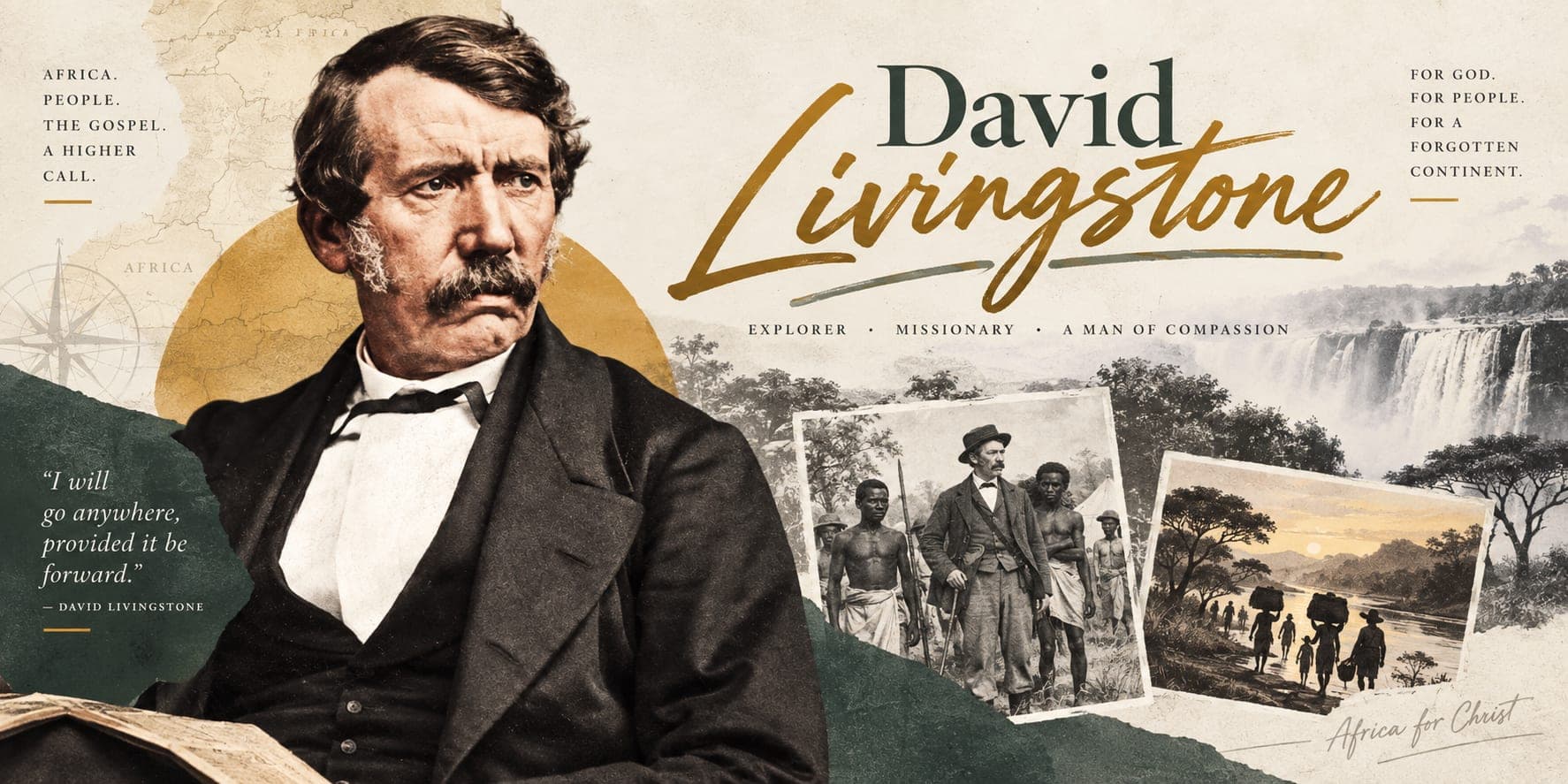
In thirty years he made one convert, and that convert went on to do more than he did
Estimates of how many people David Livingstone converted in thirty years in Africa vary between one and none.
The variation exists because Livingstone wrote off his single convert as a backslider within five months of baptising him. That man was Sechele, kgosi of the BaKwena. At his death in 1892 he ruled about thirty thousand people, most of them Christian, and the historian Neil Parsons of the University of Botswana judges that he did more to spread Christianity in nineteenth-century southern Africa than virtually any single European missionary.
Livingstone's own birthplace museum in Scotland puts it without flinching: his success as a missionary was limited, and Sechele's was not.
Less than a minute at a time
He was born in 1813 at Shuttle Row, mill housing on the Clyde, into one room that at its fullest held seven people. The building held twenty-four families.
At ten he went into the cotton mill as a piecer, ducking under the moving spinning jenny to tie broken threads. The mill ran from six in the morning until eight at night, with forty minutes for breakfast and forty-five for dinner. It had among the longest hours in Scotland.
With part of his first week's wages he bought a Latin grammar. He went to night school from eight until ten, then read at home until midnight or later, in his own words, "if my mother did not interfere by jumping up and snatching the books out of my hands". He had to be back at the machine at six.
He also propped the book on the spinning jenny and read a line each time he passed it. His biographer worked out what that meant in practice.
The utmost interval that Livingstone could have for reading at one time was less than a minute.
W. G. Blaikie, on Livingstone reading at the mill
He knew Virgil and Horace at sixteen. At twenty-three he began at Anderson's University in Glasgow, walking the eight miles in from Blantyre every Monday of term and returning to the mill in the vacations. He qualified in medicine in November 1840 and sailed that December. He had wanted China. The Opium Wars closed it, so he went to southern Africa instead, arriving in March 1841.
One convert, and what it cost him
Sechele was a rainmaker, which in his society was a public office and not a superstition, and he had five wives. Livingstone required him to give up both. It took three years to get to the second, and the baptism came in 1848, during the worst drought anyone could remember.
Livingstone described the town the next morning: "a general consternation seemed to have seized both young and old. The town was as quiet as if it had been a Sunday. Many of the spectators were in tears, but these were in general tears of sorrow for the loss of their rainmaker."
Five months later one of the divorced wives was found to be pregnant. Livingstone's journal records his own reaction, that the news "loosened all my bones", and his decision: "Cut him off for a season." Not excommunicated. Suspended.
What Sechele said in reply is the sentence worth carrying out of this article.
Do not give me up because of this. I shall never give up Jesus. You and I will stand before him together.
Sechele, kgosi of the BaKwena, 1849
The two men last met in 1852. Livingstone spent years calling him an apostate, then a backslider though not an apostate. In a field diary of 1870, twenty-two years after the baptism and alone in central Africa, he wrote: "I solemnly declare that I considered him to be a true Christian. The first extempore prayer he uttered in my presence could not have been learned but from the Holy Spirit."
By then Sechele had been leading services himself for two decades. When the first British missionaries reached the Ndebele in 1859 they found people already holding Christian prayers. Sechele had got there first.
The expedition that was recalled
Livingstone resigned from the London Missionary Society in 1857. His book had made him wealthy and famous, and the Society would not fund work that was not direct evangelism.
What followed was the Zambezi expedition, planned for two years, funded with five thousand pounds of government money, and lasting six and a half. The rapids he had promised were navigable turned out to be impassable at any water level, which he discovered only after making the promise. The steam launch burned tons of hardwood a day, choked on its own ash, and was nicknamed the Asthmatic. His expedition doctor wrote that he could come to no other conclusion than that Livingstone was out of his mind and a most unsafe leader. He dismissed two of his best men on charges that did not stand up, and never gave one of them a hearing.
In April 1862 his wife Mary died of malaria at Shupanga, aged forty-one. She had been born in Africa, spoke Tswana fluently, and was well enough known in southern Africa that he was sometimes introduced as her husband. In eighteen years of marriage they had spent eight in each other's company. His journal: "For the first time in my life I feel willing to die." His published account of the expedition says almost nothing about it.
The Foreign Office recalled the expedition in 1863. The Times: "We were promised cotton, sugar, and indigo, and of course we get none. We were promised converts to the gospel, and not a one has been made."
The market at Nyangwe
On 15 July 1871, at a market village on the Lualaba, Livingstone watched armed men open fire on a crowd of two to three thousand people, most of them women. He had left the market minutes before it started. A second party fired on those running for the canoes. He counted seventeen villages burning that day and six the next. The dead were put at between four and five hundred, a figure he was careful to attribute to the traders themselves rather than to his own count.
His field diary that day says: "It is awful, terrible." The next: "Hell without the fire and brimstone." He had been writing for months in ink improvised from berries and cloth dye. To record this he switched to his last reserve of proper iron gall ink, so that the words would not fade.
Four months later Henry Stanley found him at Ujiji and carried out a letter describing the massacre. Published in 1872, it was the only account of Nyangwe to appear in Livingstone's lifetime, and it landed, as the historian Dorothy Helly puts it, in the middle of a well-planned campaign already under way to end the seaborne slave trade.
He died on 1 May 1873. Five weeks later the Sultan of Zanzibar signed a treaty closing the slave market there. The link is usually drawn as cause and effect and it will not bear that weight: the British envoy had already been refused once in January, and the signature was finally obtained under an explicit threat of naval blockade. The market closed. Slavery in Zanzibar was not abolished for another quarter century.
The part that is not his
He died at Chitambo's village in what is now Zambia, in the small hours, and the men with him then did something that has no obvious parallel.
They buried his heart under a tree. They dried and salted the body, bent the legs back to shorten it, wrapped it in calico and bark and tarred sailcloth, and carried it about a thousand miles to the coast, walking for nine months. One community refused them passage for carrying human remains. When a British relief expedition met them and urged them to bury it, they refused and kept walking.
Two men led that march. Abdullah Susi was from Shupanga and had joined the Zambezi expedition as a woodcutter; he built the stretcher that carried Livingstone at the end, and carved his name into the bark of the burial tree. James Chuma had been freed from a slave caravan by Livingstone in 1861, aged about eleven.
Why this belongs in an Indian magazine
Because of where those men were educated.
Chuma sailed to India with Livingstone and spent 1864 and 1865 at a school in Bombay. Jacob Wainwright, who kept the only handwritten eyewitness account of Livingstone's death, had been enslaved as a boy near Kilwa, freed by a British ship, brought to Bombay at seven or eight, and schooled by the Church Missionary Society at Nasik. The Royal Geographical Society calls this group the Bombay Africans. At least thirty of them are identifiable.
Before they sailed, they were told plainly what the job was: if he were dead, they must find his grave and bring back his bones.
Wainwright walked in the funeral procession at Westminster Abbey and threw a palm branch into the grave. Chuma and Susi reached England after the funeral was over. The gravestone reads BROUGHT BY FAITHFUL HANDS OVER LAND AND SEA. It is the only mention of them, and it names nobody.
The honest criticism
In 1857 at Cambridge, Livingstone told an audience he was going back to Africa to make an open path for commerce and Christianity, and asked them to carry out the work he had begun. He believed legitimate trade would drive out the slave trade. The idea was not originally his and the consequences were not what he pictured.
The first Commissioner of the British Central Africa Protectorate wrote in 1891 that Livingstone's work was nearing the fruition he longed for, under the flag he loved. The town of Livingstone in Zambia was founded by Cecil Rhodes's company, and its museum was called the Rhodes-Livingstone Museum until 1966. Fidelis Nkomazana of the University of Botswana puts it as fairly as it can be put: the drive to open Africa did contribute to European imperialism, but it would be wrong to say Livingstone consciously promoted it.
Against that, said with equal plainness: he had no patience with the racial theories then hardening across Europe and America, wrote about the "stupid prejudice against colour", and argued that slavery produced racial contempt rather than the reverse. He attacked Boer treatment of Africans from the day he arrived and paid for it. He was also capable of worse than inconsistency. In 1871, having failed to buy a canoe from a chief called Kalenga, he sent his men to flog him, and then cut the episode to a few sentences in the version he prepared for publication.
So what, in 2026?
Livingstone's life does not work as an argument for going somewhere far away and succeeding. He went, and by the terms he set himself he failed: one convert, one expedition recalled, a wife buried on a riverbank, and, in his own words, "we were made the unwilling instruments of extending the slave trade".
What survived him was not the plan. It was a chief in Botswana who took the thing seriously enough to keep it after the missionary gave up on him, and thirty thousand people who heard it from Sechele rather than from Livingstone. It was two men schooled in Bombay and Nasik who walked a thousand miles with a body because they had said they would.
Museums in Scotland now hang the questions on the wall rather than the answers: he accepted help from slave traders, so why is he remembered as an abolitionist? He is called a hero in books and films and in his own writing, so who are the other heroes of this story? Those are good questions to put to a famous man, and better ones to put to yourself.
Missionary story · Africa · Slavery · India