Afghanistan's first Christian channel chose satellite over the internet. Only one of those has an off switch in Kabul.
On Saturday 24 October, a channel called Mozhda began broadcasting into Afghanistan in Dari and Pashto. Its founders describe it as the first Afghan Christian television channel. Hazaragi, Uzbek, Turkmen and Baluchi are planned — the kind of small-language commitment that usually takes decades to honour.
Its executive director, Masoud Ghorbani, explained the choice of platform in one flat sentence.
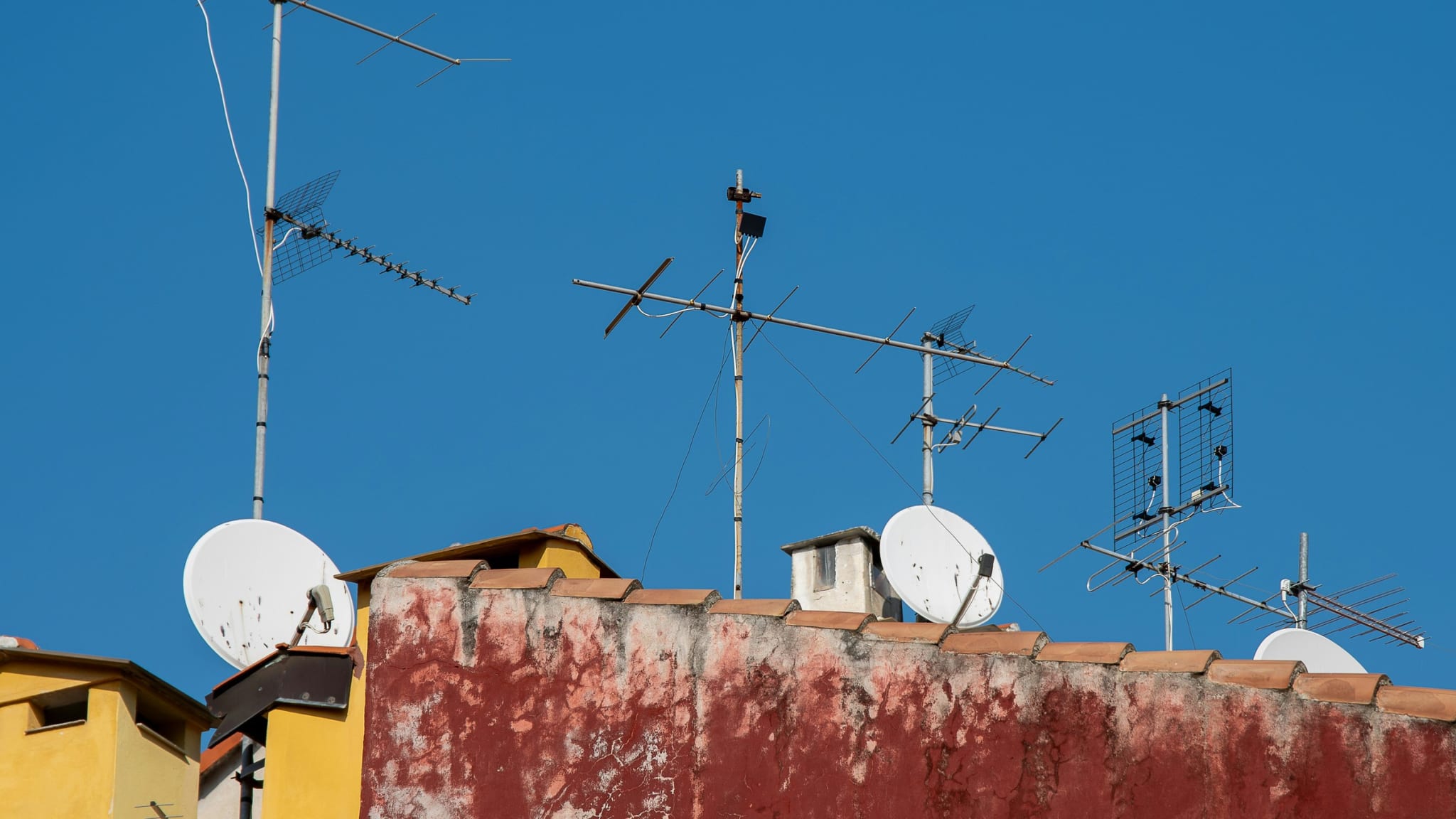
Almost everyone has a television and a satellite dish at home.
That sounds like a remark about reach. It is really a remark about engineering, and it is the most interesting decision the channel has made.
The off switch
In late September 2025 the internet went dark across Afghanistan. Fibre was cut on the authorities' instruction, mobile networks followed, and the country spent roughly two days unable to call out. The stated reason was a morality crackdown. The Taliban afterwards rejected reports that a nationwide ban had been imposed at all.
Whatever it was, it demonstrated the thing that matters here. Afghanistan's internet has a switch, and the switch is in Kabul.
A satellite signal does not work that way. It is sent up from somewhere else entirely and comes down over the whole footprint at once, and no ministry on the ground can turn it off. It can be jammed, at cost and with effort. Dishes can be confiscated one roof at a time. But the broadcast itself sits outside the reach of the people who object to it.
Choosing satellite in 2026 looks like a concession to old technology. It is the opposite. It is the only distribution method in the country that cannot be revoked by a decision taken in the capital. Every publisher eventually runs into the same question, which is not what to make but what people can actually open.
What it is actually broadcasting
Here the story gets less familiar than the launch coverage suggests.
Mozhda's team has been recording since March, and the programming they describe as central is not the sermons. It is material for women: health content, series designed to be watched privately at home, and, in the channel's own description, content to help them continue their studies.
That last phrase is doing a great deal of work, and it deserves to be read carefully. Mozhda has not said it is teaching the national curriculum. But it has said it is broadcasting, to women, at home, something meant to keep their education going.
Which puts it in a category that already exists.
Somebody is already doing this
Begum TV broadcasts into Afghanistan from Paris. It was set up by the Begum Organization for Women, founded by the Afghan journalist Hamida Aman, with a grant from the Malala Fund. Its output is video courses covering the Afghan school curriculum, grades seven to twelve, delivered by satellite into Afghan homes.
It exists for a plain reason. Girls' secondary schools closed to them in March 2022. Women were barred from universities that December. In August this year UNESCO put the number of girls shut out of secondary education since 2021 at about 2.4 million, and warned that the ban "risks condemning Afghanistan to decades of lost potential, deepening poverty, and irreversible harm."
The agency's other figures are worse than the headline one. More than ninety per cent of ten-year-olds in Afghanistan cannot read a simple text. National literacy stands at thirty-seven per cent. By 2030 the country is projected to be short of more than eleven thousand qualified female teachers — the shortage compounding, because the women who would have trained to teach are the ones currently not in school.
So when a satellite channel says it is helping Afghan women continue their studies, it is not a vague gesture at empowerment. It is a workaround for a closed school system, and Mozhda is the second channel to attempt it.
Where the pressure actually lands
The Begum story also carries the warning.
On 4 February 2025, Taliban intelligence agents raided Radio Begum — the organisation's FM station inside the country, on air since March 2021. They suspended its broadcasts, confiscated computers, hard drives and phones, and detained two media workers. The Ministry of Information and Culture accused the station of non-compliance with regulations and of collaborating with a foreign-based television network it did not name. Radio Begum denied it. The station was back on air on 23 February.
Note what could be reached and what could not. Not the satellite, which sits outside anyone's jurisdiction. The studio in Kabul, the hard drives, and two people whose names were never published.
That is how this gets fought. The uplink is safe. The person recording in Kabul is not.
Mozhda's named leadership is almost entirely outside the country — Ghorbani; Mikael Tunér, a producer with nearly twenty years at the Persian-language channel SAT-7 PARS; Shoaib Ebadi of the Afghanistan Bible Society, who sent a recorded message; Harun Ibrahim of Al Hayat Ministries, who traces the idea back to a youth camp near Tampere in 1986. That distance is the channel's protection. It is also its ceiling, because a broadcast cannot do the thing a present person does.
And it means the risk does not sit with the broadcasters. Ghorbani said as much at the launch, and it is the most honest line anyone connected to the channel has offered.
We don't know who is watching our program for the first time right now, perhaps even the Taliban.
Masoud Ghorbani, executive director, Mozhda TV
Tunér has told a Finnish outlet that several thousand Christians live in Afghanistan and that underground churches exist, against the official position that there are none. It is an estimate, and by the nature of the thing it cannot be checked. Whatever the number, the people it describes are the ones carrying the consequences of a signal beamed in from Europe.
This was tested in Indian villages fifty years ago
The model Afghan women are now depending on is not new, and India ran the largest early trial of it.
From 1 August 1975 to 31 July 1976, India borrowed a NASA satellite — ATS-6, parked over the subcontinent for a year — and used it to broadcast instructional television directly into roughly 2,400 villages across twenty districts in six states. Ninety minutes of school programming during the day, two and a half hours for adults in the evening, in four languages. Teacher training for around a hundred thousand primary teachers.
Close to eighty per cent of the chosen villages had no electricity. About a hundred and fifty of them ran their sets on solar panels and batteries. Early in the year, between two hundred and six hundred people crowded around a single television.
It worked well enough to shape India's entire satellite programme afterwards. And it ended on schedule, because it was an experiment, and experiments have end dates.
That is the difference worth naming. India switched its instructional satellite on to find out whether the idea worked. Afghan women are watching theirs because the alternative has been taken away, and nobody involved can say when it comes back.
Sources
- Mozhda TV goes on air as first Afghan Christian TV channel in historic launch, 26 October 2026, Christian Daily International
- Afghan Christian TV channel launches to share the Gospel despite Taliban restrictions, 26 October 2026, The Christian Post
- Taliban have barred 2.4 million Afghan girls from secondary school since 2021, UNESCO says, 16 August 2026, UNESCO via Reuters
- Taliban detains 2 media workers, suspends women-run broadcaster Radio Begum, 6 February 2025, Committee to Protect Journalists
- Begum Organization for Women is using television to give Afghan girls access to education, Malala Fund
- Communications restored in Afghanistan after two-day nationwide blackout, late September 2025, RFE/RL
- The Taliban rejects reports of nationwide internet ban in Afghanistan, 1 October 2025, Al Jazeera
- Satellite Instructional Television Experiment (SITE), India, 1 August 1975 to 31 July 1976, ISRO / NASA

5Talents
Written by the 5Talents editorial desk.