Before the stadium, a job fair. That is the part worth noticing.

To reach the main hall at Sound Barrier on Saturday you walked through a job fair.
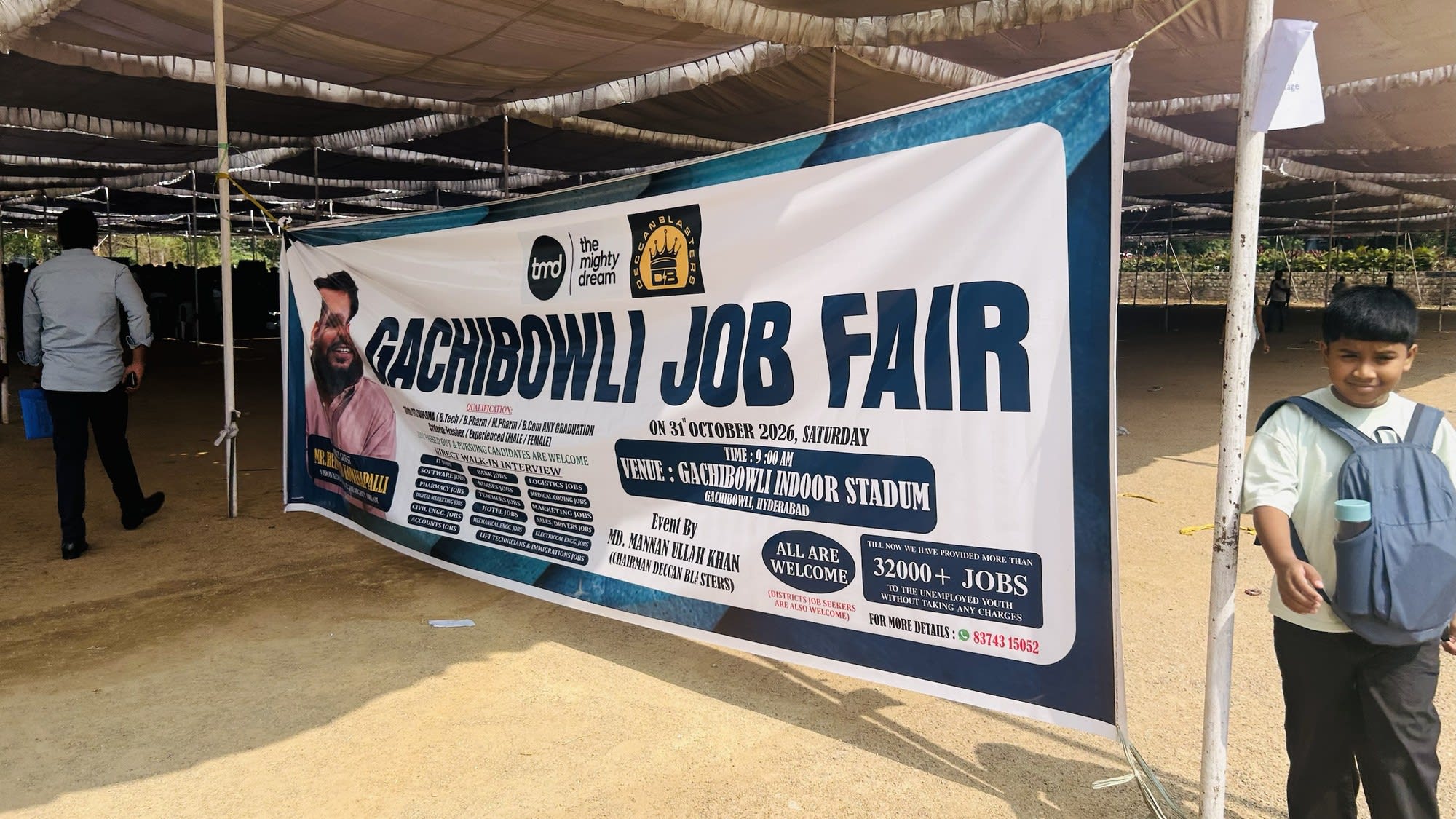
Not a careers corner. A tented ground outside the stadium where more than fifty companies ran direct walk-in interviews from nine in the morning: the Gachibowli Job Fair, organised by The Mighty Dream in collaboration with Md. Mannan Ullah Khan, chairman of Deccan Blasters.
Who it was for
The categories on offer say who it was for: software, banking, pharmacy, nursing, logistics, digital marketing, teaching, medical coding, civil, mechanical and electrical engineering, hotels, marketing, accounts, sales and driving, lift technicians, immigration. The qualifications bar was set low and wide — diploma, intermediate, B.Tech, B.Pharm, M.Pharm, B.Com or any graduation, fresher or experienced, male or female, and candidates still pursuing their studies as well as those who had finished.
"All are welcome," it says, and then, in brackets, that job seekers from the districts are welcome too — which in Telangana means the young people who come into Hyderabad looking for work rather than the ones who already live there.
The organisers put their own running total at more than 32,000 jobs provided to unemployed youth to date, without taking any charges from the job seeker.
Why that matters
Christian organisations in India run employment drives all the time. What is unusual here is the placing.
This was not a side room for those who wanted it. It was a free, open, walk-in recruitment drive at the front door of a ticketed leadership conference, advertised to the general public, costing the job seeker nothing and requiring no one to sit through a session or share a conviction to use it.
Most conferences of this kind sell inspiration and leave the economics to the attendee. This one put the interviews between the car park and the worship set.
The trade show
Inside the perimeter ran the Business and Trade Show, pitched by the organisers at "businesses, startups, and organizations" wanting exposure, partnerships or clients.
In practice, across some twenty stalls, it read as a Christian high street: a stall printing custom T-shirts, a working chef, handmade crafts, a Christian bookseller, a counter selling kunafa, and a stand for CPS, a printed Christian magazine.
A printed Christian magazine taking a stall at a leadership conference in 2026 is its own small story, and one we should come back to.
Lunch with the practitioners
The third strand ran over the lunch hour under the name Collide — more than twenty-five short sessions with working professionals, each built around what that person actually does rather than what they believe about it.
The line-up leaned hard on public service. Four serving police officers took sessions: circle inspector G.S. Daniel, inspector C. Visal, and sub-inspectors A. E. Philip Dorado and CH Sunny of the Hyderabad city armed reserve. With them were Sree Chandra, an advocate with the Government of Telangana, and Samson Sandeep, a retired officer of the South Central Railway.
The rest covered the ground a graduate in Hyderabad is actually looking at. Josiah Sagar on digital transformation and Lazarus on software development. Prashanth Joel on measurement and digital analytics. Chakrivardhan on personal finance. Vijay Coramati, marketing chief at the Deccan Chronicle, on marketing. Prince Mulla and Elisha Lawrence on music and ministry.
For a conference whose main stage dealt in calling, the lunch hour dealt in jobs people hold. A nineteen-year-old could queue for an interview in the morning and sit with a serving inspector or a newspaper's marketing chief in the afternoon.

The room
Inside, the floor of the stadium was packed and standing through the worship sets, with the tiered seating filling for the teaching. The organisers put attendance above 3,000.
Delegates wore a lanyard card that read "The signal doesn't end here," with a QR code beneath it.
Three voices carried the day, with Sam Alex Pasula, Phebe Bright and Tali Angh leading worship. Benjamin Komanapalli Jr. opened. Justin Owens spoke second. Reinhard Komanapalli, who founded The Mighty Dream and also runs a business development company called The Havilah Co., closed.

Komanapalli Jr. preached on breaking barriers, and worked largely from the unseen: Hebrews 11 and the claim that what is visible was made out of what is not, and the two questions God puts to Adam in Genesis 3 — where are you, and who told you? His application was practical rather than mystical. Do not be a barrier to yourself. Keep going on strength that is not your own. Break the barrier for your family and the generation behind you.
Owens built his session on a single chain, which he put on the screen in four lines:
What you hear shapes what you believe. What you believe influences what you say. What you say can guide what you repeatedly practice. What you repeatedly practice is who you become.
Underneath it, the same thing as a sequence — hear, believe, say, practice — and beneath that, what each stage produces: beliefs, then language, then decisions, then habits.
It is a tidy argument and a familiar one. Its usefulness is that it puts language in the middle of the chain rather than at the end. You do not talk about what you have become. You become what you have talked about.
The founder's thesis
Reinhard Komanapalli spent his closing session on why the conference is called what it is, and the answer is not aviation.
His claim is that a pattern runs through Scripture and through ordinary life in which the sound of a thing arrives before the thing. God speaks and then there is light. Trumpets sound and Jericho falls. Elijah hears rain before rain. A baby develops hearing before sight and knows its parents' voices before it sees their faces. You hear the rails before you see the train. The conference hashtag was #BeforeThereWasLight.
From that he draws a working instruction: a vision you cannot articulate is a vision you cannot build, and the discipline is to find words for it.
The most useful thing he said was autobiographical rather than theological. He first wrote this conference down on paper in 2012 and did nothing with it until 2024, and he described those intervening years not as waiting but as developing a vocabulary for a vision he could not yet see clearly himself. For a founder on a stage, in front of a room he has finally filled, that is an unusually unglamorous account of how it happened.
He closed on three reasons to speak: that a vision kept inside cannot be built with anyone, that someone else's opportunity may sit on the far side of your first step, and that what you say outlives you. The inheritance worth leaving, he argued, is a vision rather than money.
The balance the day struck
The two ends of the programme pulled in directions that together make a whole.
Komanapalli Jr. opened on a note his session kept returning to: you do not determine your future, God does. Reinhard Komanapalli closed on the creative weight of what you say. Held together those are not in conflict, and the pairing is the older and steadier version of this teaching — words matter, and they are not the lever. A day that keeps both halves in the room is doing something careful.
What survives from all three sessions is the plainest version of it, and the one most useful on a Monday: you cannot pursue what you cannot name, and the work of naming it is slow.
What the day was
Strip the stagecraft and The Mighty Dream built something fairly rare: a leadership conference that treats employment as part of the ministry rather than the overflow from it.
A young person in Hyderabad could have spent ₹400, walked into an interview without paying a rupee for the privilege, spent the lunch hour with someone twenty years into the career they are considering, bought a book, and heard three people argue that what they say about their future has something to do with whether it arrives.


Sources
- Sound Barrier conference site, for dates, venue, ticket prices, the job fair and trade show descriptions and the speaker list, checked 1 November 2026, The Mighty Dream
- About, for Reinhard Komanapalli's role and The Havilah Co., The Mighty Dream
- Reported from attendance at the conference and the job fair on 31 October 2026, including the Gachibowli Job Fair banner, the Collide session list and the slide quoted from Justin Owens' session, 5Talents

5Talents
Written by the 5Talents editorial desk.