Among the most devout teenagers, Jesus and the Bible outrank everyone except mum

Barna put a simple question to 1,500 American teenagers earlier this year: if you had questions about your identity, who would you feel most comfortable asking?
Mothers came first, at 84 per cent. Fathers next at 78, close friends at 75. Jesus came fourth on the whole sample, at 68 per cent, ahead of adult mentors and teachers, both on 67. The Bible was on 66, which puts it ahead of pastors at 56 and youth pastors at 51.
Narrow it to the teenagers who are actually formed by all this and the order changes. Among the group Barna calls Faith-Activated, Jesus and the Bible tie at 78 per cent. Only mothers, on 80, come higher. A youth pastor is on 71.

That is worth sitting with before the rest. For the teenagers who have been discipled, the Bible is not a book they are told to read. It is a place they would go with a question about themselves, and it ranks above every adult in their life except one.
Then the part nobody expects
The same group is the most willing to ask a machine.
Forty-nine per cent of Faith-Activated teenagers strongly agree that they trust technology and AI for helpful information, against 29 per cent of teenagers overall. Forty-six per cent say AI feels like a safe place to ask questions, against 28. And 45 per cent would rather ask a digital tool than a person, against 26.
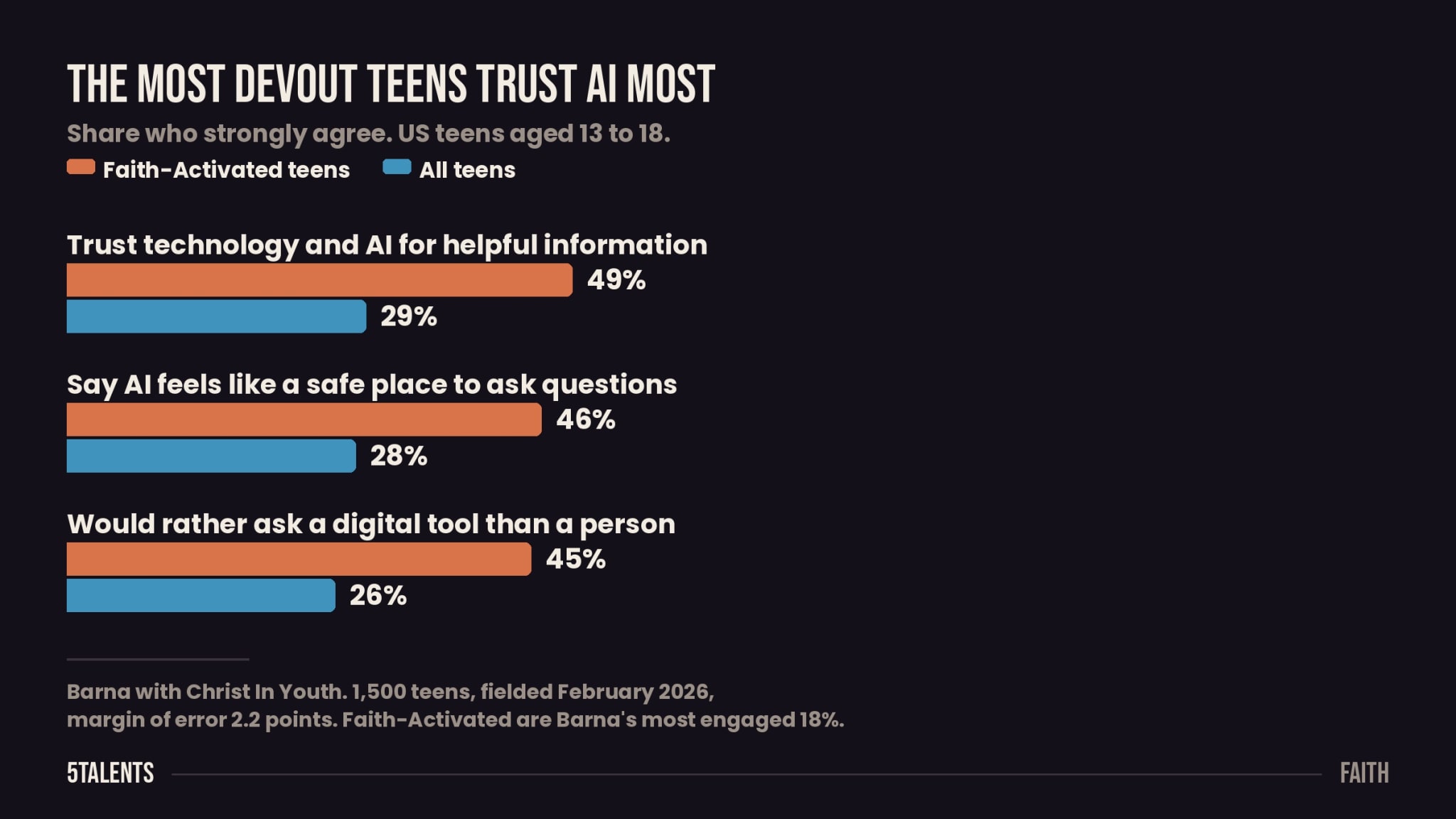
Every one of those gaps runs the opposite way to the assumption. The expectation is that the more a young person is anchored in a church, the warier they will be of the machine. The data says the reverse, and by roughly twenty points each time.
There is a reading of that which is not alarming at all. A teenager who is confident about where truth comes from may be less frightened of a search box than one who is not, in the way that a person who can cook is relaxed about a recipe. Barna does not test that explanation, and neither can we. But it fits the numbers better than panic does.
Somewhere, by definition
Richard Hamilton, a youth pastor at Castle Hills Christian Church quoted in Barna's release, puts the practical version of it: "When students are questioning who they are, they're going to go somewhere." The job, he says, is to make sure "a trusted adult, not an algorithm, is in that space".
That is close to the line Christian Vision's managing director drew ahead of Digital Day this week — that the one thing a ministry must never do is let the machine pretend to be a person. Barna's numbers show why that rule has teeth. The teenagers most likely to accept an answer from a machine are the ones a church has already spent years forming.
It also explains the shape of the apps now being built for them. YouVersion's Bible Loop, which was tested in India before it went worldwide, is a daily check-in and a memorisation game rather than a chatbot. On this evidence that is the right instinct: give a teenager somewhere to go that is neither a stranger nor a simulation of one.
What this does not tell us
Every teenager in this survey is American. There is no Indian figure here and we are not going to invent one. Whether a sixteen-year-old in Hyderabad or Aizawl would put a parent first, or Jesus fourth, or an AI anywhere on the list at all, is not something Barna asked and not something we know.
What does travel is the question underneath. A teenager working out who they are will ask somebody. The finding worth carrying into a youth group anywhere is that being the trusted adult in that moment is a contest you can actually win, because the mothers at the top of this list are winning it, and so is the Bible.
One more figure from the same body of work, which may be the most useful thing in it. Barna found 70 per cent of teenagers feel pressure to answer the question of who they really are, and only 48 per cent strongly agree they have a clear sense of it. The gap between those two numbers is the whole job. A youth ministry leader Barna quotes, Deborah Spooner, offers the encouragement: "Students are listening more than it seems."
Barna surveyed 1,500 teenagers aged 13 to 18 between 14 and 17 February 2026, with a margin of error of 2.2 percentage points. The figures here are from its free published release; the full report is a paid product and we have not bought it.
Questions people are asking
Who do teenagers trust most for advice about identity? Their mothers, at 84 per cent, followed by fathers at 78 and close friends at 75. Jesus is fourth on 68 per cent across all teenagers surveyed.
Where does the Bible rank? Sixty-six per cent across all teenagers, which places it above pastors on 56 and youth pastors on 51. Among the most spiritually engaged teenagers it rises to 78 per cent.
What does Faith-Activated mean? It is Barna's label for its most spiritually engaged teenagers: those scoring 75 or above on at least five of six pathways, covering spiritual practices, evangelism, service, faith integration, belonging and a sense of calling. They are 18 per cent of American teenagers.
Do religious teenagers trust AI more or less? More, on all three measures Barna published. Forty-nine per cent of Faith-Activated teenagers strongly agree they trust AI for helpful information against 29 per cent overall, 46 against 28 say it feels like a safe place to ask, and 45 against 26 would rather ask a digital tool than a person.
Does this include Indian teenagers? No. The survey is of United States teenagers only. Barna published no Indian or Asian data in this release and nothing here should be read as describing teenagers in India.
Who ran the survey, and when? Barna, in partnership with Christ In Youth, as part of a report called Reimagining Ministry for Gen Alpha. Fieldwork ran from 14 to 17 February 2026 and the release was published on 26 October 2026.
Is the full report free? No. The summary release and its data pages are free to read on barna.com. The full report is sold separately.
Sources

Premasis Satman
Founder and Executive Director of 5Talents Magazine, writing from Hyderabad. He has written the magazine's editorial column since the first issue in July 2012.